
Motions and policy
Motions
Motions to branch General Meetings are the means by which the branch makes decisions, establishes local policy and submits to UCU Congress and HE Sector Conference. If you have questions about how to create and submit a motion, email us at ucu@ed.ac.uk.
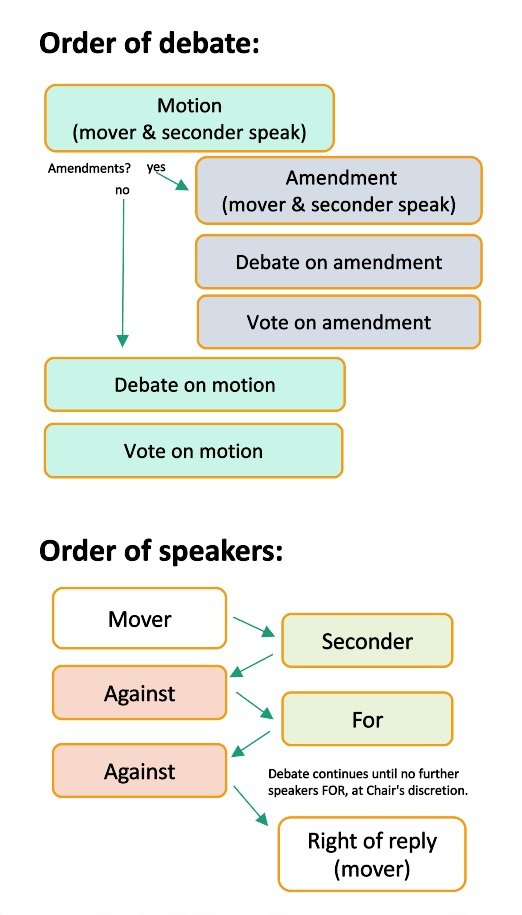
The order typically observed at general meetings for discussion and debate of motions and amendments is as follows:
Motions passed
(there is a slight delay between motions being passed and added to this webpage; thanks for your patience)
2026
GM 9 March 2026
-
Proposer: Andrew Bates
Seconder: Lena Wånggren
UCU notes that:
Members are rightly concerned about redundancies among permanent staff, but for casualised workers, hidden redundancies are business as usual.
There is widespread use of ‘open-ended contracts with review date’; contracts that sound secure, yet offer minimal job security, cause stress and anxiety, and lead to hidden redundancies.
While these contracts (also called ‘permanent finite’, ‘open-ended fixed-term’) fulfill employers’ legal obligations, in reality these fake open-ended contracts do not offer more job security, leaving workers trapped in precarious employment situations for many years.
UCU resolves to:
Campaign against the use of open-ended/review date contracts by suggesting alternative approaches:
- Move employees onto permanent contracts, providing much-needed stability to the HE sector
- Establish pools of researchers, to share work between existing employees
- Make bridging funds available to avoid compulsory redundancies due to gaps in external funding
- Call out employers’ misuse of these damaging and misleading contracts
-
MOVER: Marion Lieutaud
SECONDER: Nik Matheou
This Branch NOTES:
Despite our efforts to engage in good faith negotiations, the Senior Management Team (SMT) has consistently breached our December agreement for meaningful consultation, both in spirit and in specifics, including but not limited to:
Excluding negotiators and barring UCUE reps from meetings related to staff restructure, because of factual communication to members concerning workshops on the restructuring of Professional Service Staff and on “academic size and shape” in CAHSS.
Refusing to engage in substantive consultation beyond the legally-mandated minimum consultation period (45 days), only to commence once “at risk of redundancy” notices are sent out. Management has indicated that all engagement prior to this notice period is “engagement and information-sharing" only, rather than consultation. Accordingly there has been no space where alternatives to Management’s cost-cutting plans and salary cuts have been invited or considered.
Refusing to provide necessary financial information for meaningful consultation within a set timeline, a defined breach as set out in our branch motion “M1: Financial transparency for meaningful consultation on budget cuts” (GM 29.01.2026), which was overwhelmingly passed by the membership.
Imposing severe confidentiality constraints on negotiators from reporting relevant information to Branch Committee and the membership as a whole, despite there being no mention of confidentiality requirements in the December agreement text.
Refusing to consider alternatives to substantial salary cuts (despite a major surplus in 2024-25) or to share timelines for “implementation” of restructuring efforts, planned to begin from May 2026.
In addition, the Casework Coordinators have reported that members are still being made redundant or pressured to leave as part of cost-cutting efforts (a further violation of the terms of the December agreement), while these staff cuts are being disingenuously presented as “business as usual”.
In September, October and December of 2025 members endorsed three separate motions committing to a Marking & Assessment Boycott (MAB):
These were “M1: Bringing UoE back to the negotiating table with escalating Industrial Action in AY2025-26” (GM 16.09.2025), “M2: Exercising Marking & Assessment Leverage in Our Industrial Action Strategy” (GM 30.10.2025), and “M1: Escalation plan for industrial action in the ongoing local dispute” (03.12.2025).
Many members have stated that they voted both for the negotiation agreement, and for December’s “M1 Escalation plan”, which would act as an industrial action failsafe should negotiations be unsuccessful.
As the motion declaring MAB as a form of ASOS for our present mandate, and the most recent motion on MAB endorsed by members, October’s “M2: Exercising Marking & Assessment Leverage” and December’s “M1 Escalation plan” will now form the basis for this element of our industrial action strategy.
December’s “M1 Escalation plan” combined a focus on strategically targeted action and financial solidarity, as well as a clear escalation plan, which both spoke to members and worried management.
Napier University UCU has recently managed to bring the threat of compulsory redundancies from ~50 down to ~5 by threatening strike action. They have decided to take 10 days of strike action to save the remaining 5 jobs and they have guaranteed their members that pay loss for 5 out of these 10 days would be covered by the union.
In the industrial action survey carried out in Semester 1 2025, over 70% of respondents stated that they would commit to donating a consistent percentage of their wages to support colleagues engaged in ongoing industrial action.
UCUE finances are some of the largest of any UCU branch in the country, and a portion of reserves can be allocated to the hardship fund, complementing fundraising efforts and financial solidarity between members.
This Branch BELIEVES:
SMT is engaged in efforts to delay any return to industrial action until the end of our current mandate, rather than negotiate meaningfully; preventing us from returning to industrial action is designed to diminish our ability to defend members’ livelihoods.
We have three key points of leverage before 31 July 2026:
Final year undergraduate projects, exams and graduations.
The last teaching days of the semester and examination season.
Lobbying MSPs ahead of the Holyrood elections on 7 May.
As demonstrated in our November 2025 strike days at the end of Semester 1, political lobbying is most effective in combination with industrial action.
These three points of leverage must now be combined to achieve an agreement from Management that no compulsory redundancies will be proposed before 31 July. Any compulsory redundancies proposed at that point - irrespective of the number - would enter a 45-day minimum consultation period lasting until mid-September at the earliest, before which no individual redundancy notices could be issued; this is when our industrial leverage will be strongest, entering the fifth month of a MAB with PGT dissertation marking arriving, and preparations for the 2026/27 academic year underway.
This Branch RESOLVES:
To organise a pledge scheme for percentage-based wage sharing, building on the responses to the Semester 1 industrial action survey, and for the branch to commit to providing at least 50% (and hopefully more) of whatever members lose through industrial action.
To call strike days from 25 March-3 April inclusive if UCU Scotland can process those dates quickly enough; otherwise to begin from Monday 30 March. Given varying leverage across local areas on these dates, members without substantial teaching or administrative responsibility are strongly encouraged to donate 10-20% of their salary in this period to support those taking strike action.
To call further targeted strike action during examinations and graduations should management not agree to no “at risk of redundancy” notices before 31 July. To include at least one day of all-out strike to foster unity in the branch, to invite Holyrood candidates to picket lines on this day, and to hold a political rally at Parliament.
Concurrently, to restart the political lobbying campaign, reach out to all Edinburgh Holyrood Candidates and ask them to commit to the fight against unnecessary staff cuts at the University of Edinburgh.
To take a strong stance on ASOS and initiate it as soon as the dispute resumes: specifically, to instruct all UCUE members to refuse to use their personal devices (phone/laptops) or personal emails for any work-related task, including two-factor verification.
EmGM 24 Feb 2026
-
Proposer: Isabelle Darmon
Seconder: Niamh Moore
This Branch notes:
1) That the branch is preparing for a new mandate, to take effect when the current period of consultations with university senior management, the temporary pause on redundancies, and the suspension of industrial action come to an end (whether at the planned date or before if needs be).
2) That under UCU rules and long-established union practice, industrial action is most effective when it is well-prepared, properly resourced, and supported by the membership.
3) That different forms of industrial action, including strike action and marking and assessment boycotts (MABs), require careful preparation, member consultation, and adequate financial support.
4) That the efforts of the Branch committee to inform members on a regular basis (Friday emails; reports on negotiations at the beginning of each branch meeting) have been and are essential to foster democratic participation and decision-making by members.
This Branch believes:
1) That the branch’s strength lies in combining negotiation, member organising, and credible preparation for industrial action, rather than treating these as alternatives.
2) That future industrial action, including a possible MAB, will only be effective if:
the timing of any MAB is considered carefully; and sufficient support mechanisms, including the hardship/strike fund, are in place.This Branch resolves:
1) To require the continuation of regular reports to branch general meetings on:
the progress of negotiations; management’s positions and claims; and areas of agreement and dispute.2) To ensure that members have adequate and robust opportunities to share their views on strategy, through branch meetings and through other democratic mechanisms.
3) To ensure that differing strategic views within the branch are heard, respected, and reflected in discussions and reports.
4) To continue urging members to donate to the branch Hardship and Fighting Fund, recognising that prolonged strike action and/or a MAB impose significant financial burdens on members, and having a base of available financial support already in place enables more members to participate if/when industrial action is called.
5) To use the existing Industrial Action Committee meetings to begin preparations for future industrial action, including consideration of a marking and assessment boycott (MAB) and the timing of MAB (e.g., consideration of end-of-semester and postgraduate dissertation marking periods).
6) That such preparation must include:
clear communication to members about risks, protections, and likely implications of industrial action, including implications of not taking any action;
realistic assessment of likely financial costs of supporting industrial action, including likely financial costs of supporting members who engage in MAB; and
credible planning to ensure action is sustainable and supported, including financial planning and fund-raising.
-
PROPOSER: Nik Matheou
SECONDER: Kate Davison
This branch notes:
There has been an exciting rise in member participation in industrial strategising since the beginning of the academic year 25/26. This shows lay members’ desire for effective strategy also reflected in large turnouts and super-majority votes in favour of strong industrial action and a continuous mandate.
Although there has been a common practice for implementing motions, a lack of clear protocol has meant that part or whole of some of those passed have been left unactioned.
UCU officials have recognised and apologised for the failings, and have proposed new practices going forwards to avoid the same issues arising in future; members of Branch Committee have also agreed in principle to the new practices.
This branch believes:
A trade union is its members, and a healthy union branch is one governed by democratic mass participation.
Participation means not just voting, but lay members taking an active role in drafting, passing and implementing industrial strategy.
Victory in our dispute will come through the widest participation possible, in strategising and drafting policy as well as in taking action.
It is the responsibility of Branch Committee members, and especially elected officers, to action members’ decisions as far as possible. Any issues regarding implementing passed motions should be brought directly to members for consultation, including proposed alternatives given changes to the branch’s priorities and circumstances.
This branch resolves:
1) Motion proposers must provide clear timeframes for industrial action, with specific reference to calendar dates as far as possible, especially for strike action.
2) In the first Branch Committee meeting following a General Meeting branch officers will consider all passed motions in tandem, actively think about the interrelationship between them, and consider potential implementation issues.
3) Branch officers will maintain an action tracker for decisions from passed motions.
4) Any clarifications or potential implementation issues for a passed motion will be discussed with the proposers by a delegated member of Branch Committee at the earliest opportunity. If deemed unactionable by Branch Committee and the proposers, then they should identify alternative proposals that maintain the spirit of the originally passed motion; alternatives must be brought to the membership as a whole in the first subsequent General Meeting.
GM 5 Feb 2026
-
Proposer Talat Ahmed
Seconder Mohan Sridharan
This branch notes:
1. The formation of the TOGETHER Alliance, initiated by Stand up to Racism which brings together over 80 civil society organisations with anti-racist and community organisations, NGOs, artists and leading public figures to mobilise against the far right and is calling a national unity demonstration on 28 March in London.
2. Nigel Farage’s Reform UK is currently leading opinion polls and set to come second in Scottish Parliament and Welsh Senedd elections and to make serious gains in English council elections in May.
3. Tommy Robinson, former member of the BNP and the founder of the EDL headed the largest ever far right demonstration in UK on September 13 and has called another demonstration on 16 May.
4. Both of them are supported by some of the world’s richest people, including Elon Musk, who are seeking to promote division in their own interests.
5. The TUC/Stand up to Racism hosted conference titled ‘Workers Against the Far Right’ bringing together delegations of trade unionists on 21 February in London.
This branch believes:
1. There is the utmost urgency in challenging the far right and the politics of RUK, which will impact profoundly and detrimentally on minority staff, students and wider community.
2. It is critical that 28 March sees London with the largest, most vibrant, united mass outpouring of inclusive, diverse antiracism.
This branch resolves:
1. To support the TOGETHER launch statement and to sign up to it.
2. To make a financial donation to SUTR of £500 to help book transport for March 28.
3. Circulate members encouraging them to attend the demonstration on March 28.
4. To back the 21 February TUC/ SUTR hosted conference, and to fund and send up to 2 delegates.
-
Proposer: Niamh Moore
Seconder: Isabelle Darmon
This branch notes:
That the branch is currently operating in a period of exceptional stress, including the threat of redundancies, high workloads, and significant anxiety among members.
That recent branch meetings, including hybrid meetings, have seen a deterioration in respectful conduct, effective chairing, and members’ confidence in safe democratic participation.
That there is a real risk that poor conduct and lack of process in meetings deters both new and old members attending and participating at a crucial time when membership needs to be higher and more engaged than ever
That a closely-fought democratic vote was held on branch strategy, and that members hold sincerely different views on the best way forward.
That all outcomes of properly conducted democratic votes must be respected, and that no member should feel unsafe, silenced, or belittled for how they voted.
That members holding different views and casting different votes at the recent ballot on Management’s offer, as is the case of the proposers of the current motion, can share similar concerns regarding the relations, communication and democratic processes in this branch.
This branch believes:
1. That the union’s strength depends on solidarity, mutual respect, and members’ confidence that meetings are conducted fairly, inclusively and safely.
2. That clear procedures and effective chairing are necessary to enable full and democratic participation, particularly in large or hybrid meetings.
3. That disagreement over strategy must not spill into bullying, intimidation, personal attacks, or the spreading of unverified or speculative claims that increase fear and distress.
4. That members of branch committee have a particular responsibility to de-escalate tensions, communicate accurately, and model respectful behaviour.
This branch resolves:
1. To reaffirm that all branch meetings will be conducted in line with UCU’s principles of respectful debate, democratic decision-making, and member wellbeing.
a) To ensure that communications during meetings clearly distinguish between agreed branch or committee positions and individual members’ personal views2. To implement clearer chairing procedures for all meetings, including:
a) consistent enforcement of meeting protocols and respectful communication
b) timely intervention by the chair where discussion becomes personal, intimidating, or inflammatory
c) clear management of chat functions in hybrid meetings to enable online members to participate
i. by appointing a chat moderator to oversee the chat, who will convey questions in the chat to the chair of the meeting
To ensure that branch meetings create space for members holding different views to speak without fear of ridicule, hostility, or reprisal.
To mandate the committee to prioritise de-escalation, accurate communication, and member wellbeing in all future meetings and communications.
To treat bullying, harassment, and intimidation within branch activities as a serious matter requiring intervention.
To recognise that heightened stress does not excuse harmful behaviour, and that the branch has a collective duty of care to its members and officers.
To mandate the committee to review the process and schedule of branch meetings with the aim of facilitating inclusive discussion amongst all members, not only on motions, but also on more open topics, including strategy. All of the above measures are necessary for rebuilding trust and facilitating meaningful dialogue within the branch. But the process of meetings also needs to be reviewed to make them less bureaucratic and prioritise democratic discussion wherever possible.
-
Proposer: Cecile Menard
Seconder: Lena Wånggren
Congress notes that:
· A large proportion of UCU members are employed on insecure contracts.
· Casualised staff face specific struggles distinct from those in more secure positions.
· Casualisation is an equalities issue, with staff on insecure contracts disproportionately being from intersectionally marginalised groups.
· Management-imposed cuts across higher education are using hidden redundancies as a cost-cutting measure to shield permanent workers from voluntary or compulsory redundancy.
· Several UCU regions (including London, North West, and South West) have an anti-casualisation officer, but no such position exists on the UCU Scotland Executive Committee.
· Regional and national anti-casualisation officers play a crucial role in linking branch-level organising with the UCU UK Anti-Casualisation Committee and in ensuring strategic campaigning against casualisation.
Congress believes that:
· Casualisation is a core trade union issue.
· Casualised staff need representation and visibility on regional and national executive committees.
Congress resolves:
· To establish and elect an anti-casualisation officer to the UCU Scotland executive committee from this Congress onward.
-
Mover: Sara Al Disi
Seconder: Nik Matheou
Congress notes:
· Western/Zionist imperialists, most notably US and Israel, are committing crimes that have radicalised and angered swaths of young people and workers.
· Not long ago, the European workers called a general strike in solidarity with the Sumud Flotilla, proclaiming “Block Everything”. Millions of people were out on mass demonstrations and engaged in industrial action.
Congress believes:
· “Block Everything” has proven that mass, direct action by the labour movement is possible and necessary.
· Ending the genocide and imperialism, which the British government is complicit in, is an urgent task.
· It is this union’s responsibility to challenge the anti-trade union laws that obstruct our ability to take action and force their repeal.
Congress resolves:
· Build for a mass movement of walkouts and strikes amongst all workers. The labour movement must start an anti-Zionist and anti-imperialist campaign in all workplaces.
· Work with other trade unions/student unions to coordinate this campaign.
-
Proposer: Lena Wånggren
Seconder: Mohan Sridharan
UCU Scotland notes:
· Increased far-right racism and anti-migrant violence in the UK, seen in racist riots, attacks on mosques and synagogues, and the 100.000 far-right demonstration in London 2025
· Reform UK is projected second in the May Scottish Parliament election
· Far-right intimidation of migrant hostels across Scotland, including Falkirk, Perth, Aberdeen, Paisley, and Dundee
· Stand Up To Racism (SUTR) and Women Against the Far Right (WAFR) Scotland’s work in exposing the far right and Reform UK, who use narratives of ‘protecting women’ to spread racism
UCU Scotland believes:
· Antiracism is a key trade union issue
· Trade unions are crucial in challenging racism and the far right
UCU Scotland resolves to:
· Send support to, circulate events organised by, and collaborate with groups such as SUTR, WAFR, and Together Alliance, and local TUCs and antiracist groups including Falkirk For All, Perth Against Racism
· Take actions to address racism within our own union
-
Proposer: Lena Wånggren
Seconder: Kate Davison
UCU Scotland notes:
· The organising work done by IWGB Game Workers including at Rockstar Games
· In October 2025, Rockstar fired over 30 staff based at Rockstar North headquarters in Edinburgh and Dundee, for their trade union activities
· IWBG calls this mass sacking ‘the most ruthless act of union busting in the history of the UK games industry’, and has started legal proceedings
· Reporting by PC Games, BBC, and Bella Caledonia
· Weekly demonstrations outside Rockstar in Edinburgh, London and Paris
UCU Scotland resolves to:
· Send messages of solidarity and a donation IWGB Game Workers for their campaign to reinstate the sacked workers and gain union recognition
· Work with STUC, Edinburgh TUC and Dundee TUC to support workers at Rockstar North
· Encourage branches to invite IWGB Rockstar speakers, and publicise solidarity events
· Send a message to employers at Rockstar North, STUC, and Scottish MSPs, to ask them to condemn this union busting
GM 29 Jan 2026
-
Proposer: Marion Lieutaud
Seconder: Andrew Jackson
UCU Edinburgh (UCUE) branch NOTES:
University of Edinburgh (UoE) Senior Management Team (SMT) claims that the University’s declining income relative to expenditure is likely to result in a financial deficit in coming years, requiring large-scale budget cuts. UoE SMT’s own figures indicate that this would be driven by a sharp rise in direct expenditure growth at UoE, whereas in the rest of the Russel group, expenditure growth has fallen.1 UoE SMT has been asked to explain and justify this unusual rise in expenditure growth multiple times (including through FOI request). They have not answered those questions.
Meanwhile, UoE’s own budget figures predict very respectable increases in income (e.g. 4.3% for CAHSS alone, from 2025/26 to 2026/27)
Yet, UoE Senior Management Team has indicated that drastic budget cuts are indispensable and necessitate large-scale staff costs cuts. A significant part of UoE workforce has already been cut through hidden redundancies (e.g. not-renewed fixed-term contracts) and voluntary severances. UoE SMT continues to refuse to rule out compulsory redundancies.
The UoE University and College Union branch (UCUE) has begun an industrial dispute in opposition to SMT’s plans, and especially with respect to staff cuts and redundancies. UCUE has been clear throughout that it does not accept the rationale that staff cuts are necessary and unavoidable, and has never seen evidence proving otherwise.
UCUE members have agreed to a temporary pause in industrial action related to this dispute, on the condition that SMT engages in “meaningful consultation” with the unions over the grounds for cuts and their planned implementation.
UCU Edinburgh branch BELIEVES:
UoE is not operating at a deficit, and SMT have not released the necessary data or modelling to explain why they believe the University will enter deficit in coming years. Financial information that has been released so far, publicly and to union representatives, does not indicate any actual realised operating loss at the University level; does not justify projections that the university will face deficit in the future driven by atypical expenditure growth; and does not explain why expenditures rose atypically in the first place.
Meaningful consultation on any proposed solution to any claimed problem requires that both parties have access to enough information that they can meaningfully contribute to the shaping of solutions. It requires establishing a shared understanding between the negotiating parties, including all relevant information, data and modelling by which either one has arrived at their conclusions.
In the absence of sufficiently detailed financial information on the period leading to the alleged financial crisis, on the specific financial projections that identify and quantify the risk of such crisis in the future, and on the assumptions that these projections are based on, UCUE is not in a position to be “meaningful consulted with”, simply because we cannot
a) Precisely understand what generated the crisis or the risk of crisis to be addressed nor
b) Design and present guidance and plausible alternative proposals to the one presented by UoE senior management.
At a minimum, the financial information required to adequately advise on SMT’s plans should include:
A clear breakdown of expenditure growth data by category of expenditure (staff, capital, etc) over time, going back at least to 2020.
A clear breakdown of the financial projections data (breaking down expenditure costs by categories) that identify and quantify the future deficit justifying the budget cuts
A clear explanation of the modelling and model assumptions underpinning those projections
Comparative data on SMT’s financial projections for 2025-2026 as they were presented in 2024 vs. the financial situation at the end of 2026.
A clear breakdown and quantification of all budget cuts and cost-saving measures made so far.
4. All this data and information already exist as it would have been necessary for UoE SMT to compile it as part of their projections and quantification of cost-saving measures so far. Anything short of direct and unfettered access to this information, including all data and modelling, does not allow for meaningful consultation.
UCU Edinburgh branch RESOLVES:
To instruct UCUE negotiators to ask SMT for the above data as a necessary pre-condition and starting ground for meaningful negotiations.
To make this a timed request (with a timeline of 2 weeks to share the data from the moment the request is officially made by UCUE negotiators, so as to avoid stalling).
To treat refusal to provide this information as a negation of the possibility of and therefore a breach of the commitment to “meaningful consultation” which SMT made in their agreement with UCUE.
-
Proposer: Nik Matheou
Seconder: Zozan Yasar
This branch notes:
Since 2011 Kurds and other groups indigenous to North-East Syria (“Rojava” in Kurdish) have been developing a system of self-governance based on popular democracy, women’s liberation, social ecology and a cooperative economy.
This remarkable example of inclusive self-determination has taken place while liberating one-third of Syria from ISIS/Daesh, resisting two invasions and occupations by jihadist groups backed by the Turkish state, under a sustained economic embargo, and without the presence of international humanitarian organisations.
In their invasions and occupations from January 2018 to January 2026, jihadist groups backed by the Turkish state and the transitional government in Damascus have committed war crimes and crimes against humanity, including extrajudicial killing, kidnapping, looting, ethnic cleansing and demographic engineering; these crimes have particularly targeted Kurds and self-organised women from all North-East Syria’s communities.
Despite a ‘tactical, transactional and temporary’ (US Envoy Tom Barrack, January 2026) military alliance with the Kurdish-led Syrian Democratic Forces against ISIS/Daesh, international powers have given no practical or political support to the Autonomous Administration of North-East Syria (AANES).
Since the fall of the Assad regime, welcomed by the people and administration of North-East Syria, AANES has consistently sought to partner with the Damascus government in the creation of an integral, democratic Syria.
This branch believes:
That progressive internationalism is a proud tradition in the workers’ movement, and trade unions have a responsibility to show solidarity with all those organising for a democratic society and cooperative economy.
That a democratic Syria where all can thrive cannot be built on the basis of military campaigns and state-enforced centralisation; all parties must participate in inclusive negotiations on the principle of decentralised autonomy for the country’s regions and peoples.
This branch resolves:
To send a statement of solidarity to Kurdish communities and the people of North-East Syria, and especially to the umbrella organisation for trade unions and worker cooperatives, TEV-DEM (the Movement for a Democratic Society).
To donate £250 pounds to the emergency appeal for North-East Syria/Rojava launched by Kurdish Red Crescent (Heyva Sor a Kurdistanê), the sole humanitarian organisation operating on the ground.
To affiliate to the Kurdistan Solidarity Campaign (KSC), and support KSC’s work publicising AANES’ demands for political recognition and support in our union structures, and across the trade union and labour movement.
To host a KSC information meeting for members, and support relevant days of action by promoting and participating in demonstrations.
2025
GM 3 Dec 2025
-
Proposer: Peaks Krafft
Seconder: Alejandro De Coss
UCU Edinburgh (UCUE) branch NOTES:
The branch has voted overwhelmingly to renew our mandate for industrial action in our ongoing local dispute regarding the University of Edinburgh (UoE) senior management’s proposed large-scale budget cuts.
UoE management has not yet fulfilled the demands of UCUE to make a commitment to no compulsory redundancies until December 2026 or to make the UoE budget and financial forecasting transparent to staff.
There was strong support in the indicative vote on 31 October 2025 General Meeting for the motion “Exercising Marking & Assessment Leverage in Our Industrial Action Strategy”.
UoE management has previously made 50% pay deductions for Marking and Assessment Boycott (MAB) actions.
UCU Edinburgh branch BELIEVES:
UoE is not operating at a deficit. The UoE financial information that has so far been publicly released and released to the unions does not indicate any actual realised operating loss at the University level, which raises questions about whether there are other motivations for the proposed cuts.
If and when UoE faces real year-on-year losses for a significant period, UoE has substantial cash reserves that could be used for investing in new teaching, research, administrative and other income generating strategies before making redundancies.
Following the review and changes to exam boards and progression at UoE, there is some uncertainty that MAB, as it was run in the past, will be as effective as it has been. UoE management may try to wait out or circumvent a MAB targeting Semester 1 marking while making large deductions to participating members. Meanwhile, a MAB targeting Semester 2 marking may also come too late to impact UoE’s plans.
When 50% pay deductions have been taken for MAB in the past, these deductions were punitive, not proportional to the actual amount of time marking and assessment takes.
If a MAB is not effective enough to force a shift in management’s response, or if disproportionate deductions are undertaken as they have been previously to undermine the action, UCUE must be prepared to escalate our industrial action.
UCUE requires an escalation plan beyond short-term strikes and MAB.
To be effective our industrial action must be commensurate with both the scale of the threats posed by UoE senior management’s proposed budget cuts and with management’s responses to our industrial action.
Engaging targeted prolonged strike action by calling only workers from certain Schools and/or Subject Areas to strike could maximise our effectiveness while preserving resources for a long strike and building long-term material solidarity between different parts of the university.
UCU Edinburgh branch RESOLVES:
To begin preparations for a period of prolonged targeted strike action by identifying which Schools and/or Subject Areas will be most effective to call to strike. To identify Schools and/or Subject areas through organising workshops and other strategies, coordinated by the Industrial Action Committee. To be ready to give notice for these groups of workers to strike. To build infrastructure for material solidarity and financial resilience (such as wage sharing solidarity schemes) in order to enable the branch to support those workers called upon to take MAB or targeted strike action, so that their pay is as little affected as possible and the financial impact is distributed among striking and non-striking members.
If UoE senior management administers disproportionate pay deductions for any UCUE industrial action such as 50% wage deductions for MAB, to engage in targeted strike action for the amount of time for which deductions are being made.
If by Week 3 of Semester 2, UoE senior management does not make a commitment to no compulsory redundancies until December 2026, to engage in targeted sustained strike action calling specific groups of workers from certain Schools and/or Subject Areas to strike in weeks 5-11 of Semester 2.
GM 30 Oct 2025
-
Proposer: Idil Akinci
Seconder: Marion Lieutaud
UCU Edinburgh notes:
The UK Equality Act 2010 does not recognise immigration status as a protected characteristic
The government’s immigration white paper proposes an “earned settlement” model extending the Indefinite Leave to Remain (ILR) qualifying period from five to ten years for many, linking eligibility to continuous employment and economic contribution.
These changes will particularly disadvantage migrant higher education staff, especially PhD students, early career researchers and others on fixed-term or casual contracts, whose employment patterns are insecure by design.
The UK has some of the highest immigration fees in the world. High visa fees and the Immigration Health Surcharge (IHS), which saw a 66% rise last year alone, create financial hardship, especially for those needing to renew visas frequently or bring family members.
Cuts, closures and redundancies across the HE sector heighten these vulnerabilities.
The government is expected to open a public consultation in November, 2025 on extending the ILR qualifying period; UCU can and should contribute to this process.
UCU Edinburgh believes:
This lack of protection in equality law leaves gaps for migrant members in practice
Immigration status is a key equality issue intersecting with race, gender, disability, class, and employment precarity.
UCU has a vital role in gathering evidence, amplifying migrant members’ voices, and shaping policy on equality, employment and settlement rights.
UCU Edinburgh resolves:
To campaign for immigration status to be recognised in UK equality law.
To develop evidence-based guidance and trainingfor migrant members and reps, informed by a nationwide survey on employment, visa and settlement challenges
Demonstrate, through evidence, how immigration status intersects with class, citizenship, race, gender, disability, employment status to create complex and often invisible inequalities that are not adequately addressed by existing equality frameworks.
To submit evidence to the forthcoming ILR consultation advocating for fair, secure, and affordable settlement pathways.
To campaign against punitive visa costs and mainstreaming of far right and anti-migrant politics and rhetoric, in solidarity with migrant justice movements.
To advocate against retroactively changing visa rules and the ILR qualifying period for migrants who already have a visa.
-
Proposer: UCU Edinburgh Branch Committee
This branch notes:In the last General Meeting and the following e-vote members voted overwhelmingly to back an industrial action strategy with a focus on targeting processes related to accrediting and ratifying degrees, recognizing that fees for degrees are the university’s central source of revenue, and so senior management is particularly sensitive to this point of leverage;
In 2023, UCUE members conducted an impactful and well-organized Marking and Assessment Boycott (MAB), with participation rates reportedly the highest in the country, and grounded in mutual support through effective fund-raising based on salary sharing;
In 2023, our employer imposed pay deductions of 50% on staff participating in the MAB, and threatened higher deductions, with deductions only being imposed when members declared they were joining the MAB.
This branch believes:
With hundreds of jobs already lost, and management insisting on imposing a staff-cutting budget in which 1000+ more jobs could be slashed, strong and effective industrial action is essential.
Targeted action on all processes going into degree classification and awards has the best chance of bringing management back to negotiations, and should include different forms of industrial action, including both strikes and ASOS.
Management’s build up to compulsory redundancies requires an immediate industrial action response, as will the announcement of CRs coming on the horizon.
This branch resolves:
1. To immediately declare a Marking and Assessment Boycott (MAB) as a form of action short of strike from the start of its new industrial action mandate (to run from 20 Nov. 2025 to 19 May 2026);
To develop School- and Subject Area-specific focused plans for MAB during the period of the branch’s second industrial action mandate, e.g. by concentrating marking;
For members in Schools and Subject Areas to declare MAB as soon as final-year undergraduate dissertation marking begins, and for all members with marking responsibilities to declare following the announcement of CRs;
To ramp up fundraising for the branch Hardship and Fighting Fund to support MABing members, including Local Contacts identifying members on research leave or without marking responsibilities for salary sharing, and fundraising drives and events;
Based on careful mapping and consultation with members, to develop plans for targeted strike action in semester 2.
To pause all industrial action if management agrees to no compulsory redundancies until December 2026, and agrees to cease all staff cuts (including Guaranteed Hours budget slashes and non-renewal of fixed-term contracts), while official Joint Union negotiations take place.
GM 16 Sept 2025
-
Moved: HCA Local Contacts
Seconded: HCA Local Contacts
Nik Matheou, Megan Hunt, Mark Slater, Kate Davison, Jonny Gardner, Freddy Fossey-Warren
This branch NOTES:
UoE Senior Management continues to implement an intended £92m in annual spending on staff via the Voluntary Severance scheme, substantial cuts to Guaranteed Hours across many Schools, non-renewal of fixed-term contracts and less favourable treatment of fixed-term staff whose contracts are not being renewed, continued restrictions in hiring and promotion, the announcement of another round of Voluntary Severance/Redundancy targeting Level 9 and 10 staff, and other restructuring measures;
According to an email from Principal Peter Mathieson on 23 June 2025, £24m of staffing cuts have been achieved so far through the Voluntary Severance scheme and reduced recruitment, which falls far short of the £92m target;
Deep cuts to budgets for employment of GH staff, as well as cuts to staff on fixed-term contracts, are not being factored into management’s totals for ‘savings’ from staff cuts, meaning these are actually greater than being claimed;
Senior Management’s attempt to portray all reductions in staff as ‘voluntary’ and claim that it is ‘avoiding’ compulsory redundancies while implementing extensive reductions in staff that are resulting in ballooning workloads for many staff who remain;
Senior Management’s strategic use of ‘siloed’ budget cuts, putting pressure on individual Schools to carry out budget cuts, presumably in order to blur the extent to which jobs are already being lost and forestall united resistance;
Principal Peter Mathieson’s June 2025 declaration to the Scottish Parliament’s Education, Children and Young People Committee that ‘there is no deficit’;
A report on salary increases for ‘key management personnel’ in The Herald on 24 August 2025, noting that ‘11 members of the university’s senior management team were paid a total of £2.4m in 2023/24’;
Senior Management continues to pursue these cuts and restructuring measures without adequate or meaningful consultation and negotiation with trade unions, when any such restructuring or budgetary change ought to require transparency, openness and the provision of a greater degree of budgetary and strategic planning information than has been provided to date;
Despite the strong turnout for our strike on Open Day in June, our ongoing ASOS and our planned strike during Welcome Week have not yet secured concessions from Senior Management or even an agreement to reopen negotiations
Our current Industrial Action mandate expires on 19 November 2025;
Our resolution from the EmGM on 3.9.2025 to request approval from UCU-UK to re-ballot to extend our mandate to late May 2026
Our standing request that Senior Management commit to no compulsory redundancies until at least July 2026, passed via branch motion in May 2025.
This branch BELIEVES:
Based on the figures above, the announcement of more aggressive measures to cut spending on staff is highly likely to be forthcoming in the near future;
The measures already being pursued are having harmful consequences beyond job losses, with increased workloads due to recruitment freezes, non-replacement of departing staff, and non-renewal of fixed term contracts, and, in the case of the VR scheme, the risk of targeting staff based on flawed and arbitrary measures of ‘academic performance’;
Maximum impact can be achieved through industrial action targeting processes related to accrediting and ratifying degrees - the university’s central ‘product’ that it ‘sells’ to students - including assessment processes and exam boards;
These are pressure points where the withdrawal of both academic and professional labour can be strategically combined to maximum effect
Key times for these processes are around mid-term (weeks 6-9) and end-of-semester assessment & examinations (December and April/May) as well as exam boards and graduations;
Targeted action allows more salary sharing/donations to the fighting fund (eg. from colleagues on research leave), and so preserves energy and resources for a longer fight, while still taking a militant, escalating approach
This branch RESOLVES:
To notify UoE Senior Management of our intention to take the following industrial action in Semester 1 AY2025-26:
action-short-of-a-strike targeting mid-term assessments and examinations in weeks 6-9 of Semester 1, causing delay to centralised processing of grades by temporarily bypassing electronic systems (e.g., Learn) in favour of returning feedback directly to students
pending extended mandate, to notify of strike action targeting end-of-semester 1 assessments and examinations from week 11 through December 2025
To build towards repeating this targeted disruption in Semester 2 (pending extended mandate), and escalating by the end of the semester to include MAB and strike action targeting exam boards and graduations
To reiterate to Senior Management that we are willing to consider calling off specific planned actions in return for
1) Meaningful, ongoing negotiations to take place consistently and according to an agreed schedule and frequency between UCU and management (as well as Joint Unions);
2) Commitment to no compulsory redundancies until December 2026;
3) Immediate stop to all further staffing cuts (including those being carried out via School budget savings targets such as GH reductions, non-replacement of departing staff, promotion freezes, etc.) until meaningful consultation occurs; and
4) Providing ‘receipts’ for the £24m claimed to have been saved so far via VS and School-administered budget savings, with more frequent and regular budget reporting going forward.
-
Proposer: Sophia Woodman
Seconder: Pieter Blue
This branch notes:
1. Since the February announcement of the proposed £140m budget cuts, management has refused to negotiate at all on the disproportionate amount allocated to cutting jobs, seeking to cut a total of £92m, with £24m ‘already saved’ due to voluntary severance and the hiring freeze. In the meantime, many jobs have already been lost due to fixed-term contracts not being renewed and reduced budgets for guaranteed-hours staff, and it is not clear whether these cuts are included in the ‘savings’ from staff.
2. Since the announcement of the £140m cut, when management said ‘nothing was off the table’ and implied that compulsory redundancies were imminent, the terrain has changed, and management is seeking to make reductions in staff appear ‘voluntary’. These changes are in part due to pressure from UCUE’s industrial action, Senate’s no-confidence vote in May and the political campaign, which have put management under pressure.
3. For those affected by hidden redundancies (FTCs ended, reduced GH work) the cuts have already had enormous impact on lives and livelihoods, while increasing the workloads of remaining staff.
4. The 2024 Joint Unions workload survey results show that the majority of staff, academic and professional services, were already overworking prior to the current round of staff cuts. Management has not responded to the workload survey, or addressed the significant health and safety implications. Since the plans for staff cuts were first mooted, Joint Unions have insisted that workload be considered in any restructuring, and management has said it will do this, but is not taking this commitment seriously.
5. Despite these plans for massive cuts to the budget for staff, so far management has brought forward no clear plans for restructuring (aside from vague slogans). While Court approved the management-proposed budget in June, it did not approve any plans for how they would be carried out. Management has failed to model the impact of the proposed cuts on income, or to present business cases for cutting courses and programmes.
6. UoE has consistently run a small number of restructures each year, sometimes leading to compulsory redundancies. In the current budget cuts, so far there are two formal restructures, with almost 40 in risk of redundancy pool, expected to lead to about a dozen redundancies. While some placed at risk seem to be finding jobs with other employers and then taking voluntary redundancy, reducing the number of people in the redundancy pool forced into compulsory redundancy, there are still likely to be some.
7. UCUE and Joint Unions are hearing news from staff of various kinds of ‘back-door restructures’ that are not compliant with current University policies, such as ‘financial restructures’. There has been a complete lack of consultation on targeting of staff on grades 9/10 for voluntary redundancy (VR), or on the specifics of restructure of professional services roles in comms and marketing, IT support and teaching offices, for example. Devolution of staff cuts to schools and units is a mechanism to avoid proper procedures for restructures, one that is creating ‘facts on the ground’ that are placing staff at risk of redundancy without notifying them as such.
8. Professional services roles are likely to be first in line for major restructuring, with plans coming out soon, informed by data and ‘benchmarking’ from management consultancy firm Nous Cubane, which has already left a trail of destruction across universities in Canada and Australia.
9. The current Senior Leadership Team has an extremely poor record of lack of accountability and transparency on finance and ‘change projects’. The lessons of the People and Money debacle, outlined in the external report to Court, have evidently been ignored. There is a pattern of mismanagement, overspending and poor planning, and the SLT appears to listen more to management consultants than to staff or the University Senate. The Joint Unions Finance Working Group reports have highlighted many of these failings, which have been the subject of questions in the Scottish Parliament and media reports.
10. At the centre of this ‘crisis’ is the erosion of academic freedom in the shape of academic self-governance and autonomy, as managers, finance experts and consultancies dictate how academic work must be done and what should be prioritized. The fact that the Senate’s vote of no-confidence in management’s plans has not received a response is a clear indication. Management’s refusal to accept meaningful academic self-governance is not in the spirit of the legal framework for higher education in Scotland.
This branch believes:
1. This will be a long fight, and we need to conserve resources, target our energies and build our strength. More specific plans for restructuring on a wider scale are likely to be forthcoming late in 2025 and 2026, and we need to be ready to respond.
2. The victory in the UCU dispute over USS pensions demonstrated that multiple tactics beyond strikes were vital, including media work, policy work, public pressure, external pressure on employers.
3. Our political and media work means our dispute is in the public eye, and we can do more to generate external pressure on management to change course.
4. Some laws and University policies give trade unions leverage to hold management to certain standards, for example on redundancies and on workload as a health and safety issue. Joint Unions can deploy these mechanisms to push back on management’s plans for job cuts.
5. Students have backed our industrial action, and management is more likely to listen to pressure from students and parents. Students are already mobilizing to document the impact of cuts on students, Joint Unions can work with them in this effort.
6. A live industrial action mandate is a threat: we have shown our resolve through strikes on 20 June and in Welcome Week, and we can call additional action during our current mandate if circumstances change.
7. During the semester, action short of strike (ASOS, working to contract, refusing to cover for absent colleagues, refusing voluntary work) can be more effective, as well as highlighting the impact of cuts already made and showing that further cuts are unworkable.
This branch resolves to:
1. Insist that management meet with UCU Edinburgh to resolve the local dispute as a matter of urgency.
2. Continue to press for serious negotiations and consultations with Joint Unions at central University level on all restructures and job cuts, insist that University policies be followed to the letter, including proper attention to equalities impacts of any changes.
3. Support and equip members to identify ‘back-door restructures’ that violate University policy on redundancies and consultations, escalate reports rapidly to management and insist on any processes in this category being halted and redone.
4. With Joint Unions, insist on negotiations on workload and a response to the JU workload survey. Launch a campaign on workload, including health and safety inspections of areas where unsafe workloads are being reported.
5. Support members in taking effective ASOS through weekly local drop-ins and individual contacts via our local contact network.
6. Document and publicise, and campaign on, the impact of staff cuts at UoE. Work closely with student groups, including EUSA, to raise student awareness of how cuts are impacting their learning environment.
7. Conduct a focused media and political campaign around the impact of cuts, mismanagement and poor governance within UoE, including insisting that Court play a proper role in UoE governance oversight, and continuing to press for scrutiny of UoE management by the Scottish Government and Parliament.
8. Leaflet UG Open Days on 4 and 24 October.
9. Declare three strike days during week 10, the last teaching week for many courses, 17-19 November, with 19 November being the first graduation date, with the intention of declaring additional strikes on graduation days, by School, in our new mandate. Sign up members for these strike days in advance.
10. During the reballot period, run the GTVO process alongside a wide consultation with members, especially professional services, and Joint Unions, to develop plans for impactful and disruptive forms of industrial action to deploy in our new mandate (20 November 2025-19 May 2026) and run a broad recruitment campaign to build our membership.
11. Continue to work with Joint Unions towards the possibility of industrial action involving all campus unions in the New Year.
AGM 19 June 2025
-
Proposer: Sara Al Disi
Seconder: Alex (no surname said in meeting)
This branch notes:
1) The arrest and detention of leading members of the Awaami Action Committee – Gilgit-Baltistan (AAC-GB), including chairman Ehsan Ali, media officer Waheed Hassan, vice chairman Mehboob Wali, and youth wing chairman Asghar Shah
2) That these comrades have been charged with “disturbing public order” for peacefully protesting restrictions on their democratic right to organise
3) That Ehsan Ali has been placed on Pakistan’s notorious “Fourth Schedule” – legislation originally designed for monitoring terrorists – severely restricting his freedom of movement
4) That the Pakistani state has been implementing an oppressive policy, plundered natural resources and overseen an exception of economic decline and inflation in the region of Gilgit-Baltistan
5) That these arrests occurred as the AAC-GB planned a meeting to address the ownership of natural resources in Gilgit-Baltistan
6) That the AAC-GB has successfully organised mass movements securing vital concessions on flour subsidies, electricity provision, healthcare, and education for communities living in extreme poverty
This branch believes:
1) These arrests represent a clear attack on democratic rights and trade union organising
2) The criminalisation of peaceful political activity sets a dangerous precedent for workers’ movements globally
3) International solidarity is essential to defend the right to organise against exploitation and oppression
4) The struggle of workers in Gilgit-Baltistan against poverty and resource extraction is part of the broader international working-class movement
This branch resolves to:
1) Condemn the politically motivated arrests and demand the immediate and unconditional release of all detained AAC-GB leaders and activists
2) Call for the removal of Ehsan Ali’s name from the Fourth Schedule and the restoration of his full democratic rights
3) Write to the Pakistani High Commissioners and Ambassadors in various pakistani embassies demanding the release of all arrested comrades and an end to state repression in Gilgit-Baltistan [Sample letter available]
4) Encourage members to participate in solidarity demonstrations and protests organised in support of the AAC-GB in front of Pakistan high commission, embassies and consulates
5) Share information about this case through union/organisation communications, social media, and educational materials
6) Affiliate to future solidarity campaigns and maintain ongoing support for democratic movements in Pakistan
This branch commits to:
1) Monitoring developments in this case and taking further action as required
2) Building links with international trade union organisations to coordinate solidarity efforts
3) Raising awareness of the broader struggle against imperialism and for workers’ rights in South Asia
4) Supporting similar movements facing state repression globally
-
Proposer: James Galbraith
Seconder: Diana Paton
The branch notes:
1) E-voting can be an effective and practical inclusion strategy when used judiciously.
2) The processes for combining advisory votes in meetings with e-votes for motions with multiple proposed amendments can be complex and confusing; as shown by recent events.
The branch believes:
1) It is important for members to clearly understand the e-voting process and the implications of their e-vote.
2) Conditional e-voting on amendments can add unnecessary complexity to branch democratic processes.
3) E-votes being cast on motions as amended during general meetings will both simplify the e-voting process and make it clearer to members what they are voting for, against or abstaining from. This is especially important during periods of industrial action where swift turn-arounds with clear outcomes are necessary.
The branch resolves:
1) By default any motions put to e-vote shall be as amended during the meeting. However, for any individual amendment, an e-vote can be taken if this is agreed by the meeting.
2) Amendments in an e-vote must be presented in a manner such that their consequentials remain the same as for the indicative vote taken in the general meeting.
-
Proposer: Elaine Newton-Bruzza
Seconder: Sophia Woodman
UCU Edinburgh notes:
1) The Trump administration’s current anti-immigrant policies, including but not limited to “[e]nding asylum and targeting immigrants: Mass deportations, enforced disappearances under the Alien Enemies Act, family separations, and harsh restrictions on the right to asylum have violated international law. These actions have torn communities apart and created a reality in which immigrants, including those who have come to the U.S. seeking safety, are pushed into the shadows, living in fear.” (Amnesty International );
2) The illegal deployment of the US National Guard and the US Marines by President Trump against the legal, peaceful political protests in support of immigrant rights in Los Angeles, California;
3) The illegal detention/kidnapping and/or deportation of persons, primarily people of colour, regardless of their status as legal residents, asylum seekers with legal permission to be in the US, international students on legal visas, and, on occasion, US citizenship, in violation of their Constitutional rights;
4) The Trump administration’s extreme dehumanization of migrants regardless of status, and the stripping of rights from minorities;
5) UCU officially recognises migrant status as an equalities issue and states, “Increasing the focus on the specific challenges faced by migrants amongst the wider trade union movement is a key priority for the union.” (UCU website)
UCU Edinburgh believes:
1) Migrant rights are a fundamental trade union issue.
2) Rights stripping undermines the fundamental basis for the principles of and laws on equality,
3) Our branch stands in solidarity with migrants subjected to state violence in the United States and all those who stand up to oppose this and insist that no one is illegal.
4) Sanctuary cities, and universities, must continue to be open and welcoming places for all who live there.
UCU Edinburgh resolves:
1) To inform our members about campaigns against the anti-migrant violence in the US, including local initiatives in Edinburgh;
2) To send a message of solidarity to United Farm Workers and other trade unions in their struggle against the dehumanization and abuse of migrant workers.
EGM 22 May 2025
-
Proposer: Branch Committee
This branch notes:
Even though UoE remains in surplus, management has announced a massive cut to the University budget of £140m over 18 months, as well as major restructuring, to address a purported future deficit;
Despite a voluntary severance scheme that will result in over 350 staff leaving UoE this summer, saving £18m, management continues to insist that further job cuts will be needed, with the aim of £72m in further savings through reducing the salaries budget;
Joint Unions have not received adequate financial disclosure to be able to conduct independent assessment of the financial situation that management is claiming merits such drastic measures, despite requesting such information over many months;
The analysis of the Joint Unions Finance Working Group shows that UoE has more than adequate resources (including substantial reserves) to weather a short term downturn in income, and there is no reason why running a deficit over several years to return to financial sustainability should not be an option (as several other universities have done);
Management’s ill-conceived plans for restructuring, and extremely poor record in implementing such centralisation projects over the past 10 years, will seriously impact working conditions for all staff at UoE if they go ahead, and damage teaching and research, the core missions of the University.
This branch believes:
Management is weaponizing uncertainty, by refusing to release information on numbers of jobs at risk, and where they may fall. More members are likely to take action once specific plans are on the table.
Given management’s 18-month timetable, and the fact that restructuring ‘workstreams’ are just starting operation, UCUE needs to be prepared for sustained action over this period to resist cuts and destructive centralisation. This means it is important to conserve our energy and take action when it is most impactful.
To be a credible threat, any industrial action proposed should be disruptive enough to bring management back to the negotiation table and address our demands for no compulsory redundancies until July 2026 (the conclusion of the 18-month timetable). This means action that large numbers of members (and potentially members of other unions) are committed to.
With a live industrial action mandate, we can propose additional forms of action at any time, following authorisation of such action by UCU HE officers and two weeks’ notice to the employer. If members choose to do so, we can also decide not to take certain forms of action that have been notified to the employer if we consider it is not the right time.
This branch resolves:
Provided our branch reaches the required voting threshold, to take the following action during the period of our mandate (20 May-19 Nov):
To begin continuous Action Short of Strike as early as possible after the conclusion of our ballot, for the entirety of our ballot period.
As notified on the ballot paper, ASOS includes: working to contract; not covering for absent colleagues; not rescheduling lectures or classes cancelled due to strike action; not sharing/uploading materials related to lectures or classes that will have been cancelled as a result of strike action; not undertaking any voluntary activities; boycott of administrative work related to implementing the cuts; boycott of Time Allocation Survey; refusing to use personal devices for work purposes.
To notify the employer of a strike day on UoE Open Day, 20 June, and to ensure massive turnout of members through a pre-strike sign-up campaign;
To notify the employer of a Marking and Assessment Boycott;
To notify the employer of five days of strike action in Welcome Week, 8-12 September 2025;
To seek a commitment from management to no compulsory redundancies until July 2026 to call off this action;
To continue our campaigns to expose the disproportionate impact of ongoing budget cuts on casualised staff, to insist on a degree of stability of employment for these staff and to call out degradation of their working conditions;
To continue to work to challenge the financial viability and impact on teaching, learning and research of management’s restructuring and centralisation plans; and continue our campaign to increase public and political scrutiny of poor management and governance at UoE;
To prepare to call strike action in response to management issuing large-scale risk of redundancy notices;
To prepare to re-ballot in autumn, so we have no gap in mandate.
EGM 5 May 2025
-
Proposer: HCA Local Contacts (Kate Davison, Megan Hunt, Jonathan Gardner, Mark Slater, Murdo Homewood, Sian Davies)
Seconder: HCA Local Contacts
This branch notes:
The robust and overwhelmingly positive results of the Consultative Ballot on Industrial Action to Oppose Compulsory Redundancies, recorded in the UCUE President’s Friday email of 17 March 2025, in which:
59% of members voted
75% of respondents expressed a willingness to take strike action
85% of respondents expressed a willingness to take action-short-of-a-strike (ASOS)
Despite this unequivocal opposition to compulsory redundancies, the results have not moved UoE senior management to change course
It is reasonable to expect that the Formal Ballot will produce similar results providing a legal mandate for industrial action
The goal of any industrial strategy is to equip union negotiators with sufficient power to force management to change course
UNISON’s local branch has entered formal dispute following its AGM on 7 March
The inspiring achievements so far in the ongoing dispute at Dundee, which according to UCU Dundee member Annalu Waller in her guest appearance at our branch meeting on 6 March are the fruits of a well-organised industrial strategy (especially longer-term strike action) within a multifaceted campaign
The powerful impact of the evidence-based critiques compiled by the Joint Unions Finance Working Group via the UCUE blog
The important interventions made on University Senate (including by UCU members) to hold the University accountable
The role played by the Industrial Action Committee in past disputes as a strategic, activist, organising body
This branch believes:
Stopping compulsory redundancies at UoE requires a multifaceted, well-organised and smart campaign with a clear, democratically decided, collective industrial strategy that is matched and supported by strong, evidence-based messaging to multiple audiences (management, students, staff, politicians, wider public)
This requires what in other contexts is regrettably dubbed a “war room” approach to strategically coordinate various parts of the campaign, including:
Industrial action plan
Negotiating goals
GTVO (can also be used strategically by negotiators)
Comms & messaging
Fighting fund
Membership
Our industrial strategy must include consideration of contingencies, eg: Plan A, Plan B, Plan C, etc.
Our industrial strategy should set core industrial goals (via motions at branch mtgs) to guide negotiators and determine action, e.g.:
UoE to permanently commit to no compulsory redundancies
UoE to end hidden redundancy measures
UoE to end unnecessary capital expenditures
UoE to freeze executive salary increases, etc.
The strongest campaign relies upon active involvement by as many members of the branch as possible, which must include democratically determining our collective course of action via motions at branch meetings and expressing views via the Local Contacts Assembly, and should include wider more participatory opportunities to help shape and organise the campaign
Industrial Action Committee is an ideal forum for coordinating this work – not as an alternative to Branch Committee or the Local Contacts Assembly, but as a wider concentric circle – alongside the Joint Unions Finance Working Group, the GTVO Organising Committee, UCU members on Senate & Court, Student Staff Solidarity Network, Student Staff Assembly, other unions and EUSA, etc.
This branch resolves:
To re-establish the Industrial Action Committee as the main organising forum for all UCU members in the current dispute, to:
further develop our industrial strategy and wider political campaign, producing motions to be presented to branch meetings
coordinate campaign activism (petitioning, media, fundraising, rosters, materials, etc.)
organise itself into sub-committees (eg. media & comms, student liason, etc.)
provide a place for ordinary members, Local Contacts and elected Branch Committee members to work together
To instruct the Branch Committee to appoint an IAC Coordinator/s responsible for ensuring that IAC meetings are scheduled and advertised.
GM 16 April 2025
-
Proposer: Kate Davison
Seconder: Gina Gwenffrewi
This branch notes:
On 26 March 2025 the Office for Students issued a ruling fining the University of Sussex £585 000 for adopting a policy protecting trans and non-binary people.1
Universities UK has expressed concern over the ruling’s implications for universities’ adherence to the Equalities Act.2
Sussex Vice Chancellor Sasha Roseneil has described the investigation leading to this ruling as ‘flawed and politically motivated’.3
The continuing hostile environment for trans and non-binary people and their allies in the UK via the media, government/s and advocacy groups.
Disingenuous accusations of ‘censorship’ and ‘cancel culture’ have been used to silence and intimidate those who have stood up against transphobia.
This branch believes that:
The OfS ruling contradicts the fundamental principles of free speech and safeguarding at UK universities.
The OfS ruling invalidates and dismantles meaningful protections against harassment and hate speech.
The OfS ruling sets a dangerous precedent for universities being fined for adopting policy deemed by the OfS and/or Scottish Funding Council to have a ‘chilling effect’, not only in relation to trans and non-binary people but potentially on other issues such as anti-racism, Palestine, or sexual harassment.
Trans and non-binary people deserve the right to free speech and protection from harassment at work and in study.
This branch resolves to:
Petition University of Edinburgh management to publicly denounce the OfS ruling and offer support to Sussex University management in their defence against it.
Direct UCU UK leadership to request an emergency meeting with Education Secretary Bridget Phillipson to convey the concerns of the UCU membership about this ruling.
Direct UCU Scotland leadership to petition the SFC to publicly distance itself from the spirit of the OfS ruling and provide assurances that it will not adopt a similar stance.
Protect academic freedom and freedom of speech for all staff and students at UK universities.
Call on UCU Scotland Executive to table a motion at the meeting on 9th May to petition/lobby the SFC / Scottish Government / other relevant bodies with jurisdiction in this area to publicly distance itself from the spirit of the OfS ruling and provide assurances that it will not adopt a similar stance.
-
Proposer: Owen Holland
Seconder: Talat Ahmed
This branch notes:
The horrific knife attack upon a student on Friday 28 March outside the main library.
The student was participating in a peaceful student-staff protest of solidarity with Palestine.
The attacker used phrases such as ‘Fuck Palestine’ and the press have reported the use of Islamophobic and Antisemitic language during the attack.
Several other students were subject to verbal racist harassment.
The inaction of security staff to protect students meant that members of the academic staff had to intervene to safeguard the students.
This branch believes:
The university’s response to the safety of students and staff on campus is inadequate at best and offensive at worst in that its communication blames the victims of racial harassment.
The inaction of security staff contributes to an escalating situation of creating unsafe atmosphere on campus and their inaction is unacceptable.
Increased racialised narrative in local elections and the toxic politics of far-right ideology alongside Reform UK’s election language of ‘mass deportations’, ‘take our country back’, etc is contaminating our society.
This branch resolves:
To demand university management for an unequivocal public acknowledgement of the racially motivated crime against antigenocide pro-Palestine and pro-divestment protesters, without blaming the victims.
To demand university senior leadership to seriously address the root causes of student and staff protests, and to implement the Academic Senate vote of May 2024 by immediately divesting from companies directly supporting Israel’s human rights and international law violations in Gaza, and the plausible violation of the 1948 Genocide Conventions.
To support the antiracist initiatives of the Summit against the far-right and Reform UK, hosted by Stand up to Racism and supported by the STUC and all unions on Saturday 31 May in Glasgow.
To support World Refugee Day march and rally with cultural gig on 21 June in Glasgow hosted by SUTR and supported by the STUC and Scottish Refugee Council.
GM 6 March 2025
-
Proposer: Sophia Woodman
Seconder: Sophia Lycouris
Conference notes:
—Destructive marketisation is imperilling jobs and degrading conditions of higher education workers —Resolution requires creative and impactful action on many fronts, using multiple tactics —Our historic USS victory highlights the importance of research and media work, as well as industrial action
—Current membership density means UCU must build broad coalitions to achieve wins for members
Resolves:
To continue media campaigns around HE as a common good, including showing how the academic vandalism of HE ‘leaders’ is impacting local communities
To propose models for addressing funding crises, including controlled student distribution
To develop local, regional and UK-wide campaigns to increase membership density and member engagement
To support branches in dispute to develop plans for impactful forms of local industrial action, not only strikes, and by organising support from across the sector
To enter into partnership agreements with other HE unions as soon as possible
-
Proposer: Cecile Menard
Seconder: Lena Wånggren
HESC notes that:
HESA data do not provide a clear picture on the extent of casualisation in HE.
Amid sector-wide budget cuts and threats of compulsory redundancies, hidden redundancies of “easily-disposable” casualised staff are already happening (hours are slashed and fixed-term contracts terminated), increasing the workload of those who remain.
HESC believes that:
Data about the true extent of casualisation in Higher Education are necessary.
Poor data invisibilise the true extent of casualisation
HESC resolves to:
Obtain the following, alongside equalities data: number of staff on casualised contracts, including time-limited open-ended contracts, continuous length of service on precarious contracts, full-time equivalent and head count of staff on hourly contracts.
Ensure that campaigns against compulsory redundancies do not disproportionally lead to budget cuts targeting casualised staff; requesting the above data is key.
Campaign against hidden redundancies alongside campaigning against compulsory redundancies.
-
Proposed by: David Rush
Seconded by: Elaine Newton-Bruzza
This branch notes that union members at Dundee are in their second week of strike action to oppose job cuts. UCUE branch committee has already voted to contribute £200 to Dundee UCU to support striking workers.*
Our branch stands in solidarity with all university workers opposing job cuts.
This branch resolves:
—To donate an additional £1000 to the Dundee UCU strike fund.
*In our branch, the limit to donations that can be approved by branch committee is £200.
GM 3 Feb 2025
-
Proposer: Cecile Menard
Seconder: Kathryn Nash
UCU Scotland notes that:
1. In the UK, approximately 75000 academics are on casualised fixed-term or hourly contracts.
2. These numbers are underestimated as many casualised staff are employed on “open-ended
contracts with review date” (OERD), which are, in all but name, fixed-term contracts.
1. Alongside more visible redundancies, there are hidden or invisible redundancies of casualised staff
whose hours are slashed and contracts are not renewed.
UCU Scotland believes that:
1. Data about the true extent of casualisation in Higher Education are necessary.
UCU Scotland resolves to request these data, covering the past five years and moving forward, from
universities:
1. Number of fixed-term vs open-ended contracts per academic family.
2. Full-time equivalent and head count of staff on hourly contracts.
3. Number of Ad-hoc payments (e.g. ‘Form 100’) used.
4. Number of academics and ARPS staff on OERD.
5. Equalities data (age, gender, race, disability) for the above.
-
Proposer: Cecile Menard
Seconder: Lena Wånggren
UCU Scotland notes that:
1. Several Scottish universities have announced voluntary and compulsory redundancy schemes,
alongside budget cuts.
2. Invisible or hidden redundancies of staff on fixed-term, open-ended with review dates and hourly
contracts are already happening, with contracts not renewed or hours reduced, dramatically
increasing the precarity of casualised staff and increasing the workload of those who remain.
UCU Scotland believes that:
1. Threats of redundancies affect all staff independent of their contract type.
2. Solidarity means protecting all workers from redundancies.
UCU Scotland resolves to:
1. Ensure that any actions opposing voluntary or compulsory redundancies does not disproportionately
affect casualised staff who could be used as “buffers” to shield others from redundancy.
2. Ensure that any campaigns against redundancies must also protect and defend the roles of casualised staff.
-
Proposer: Sophia Woodman
Seconder: Sophia Lycouris
Congress notes:
1. The 12 Dec. HEC decision to call a UK ballot for IA ‘immediately’
2. That the potential timetable for IA following this ballot would fall outside the teaching period for
most Scottish branches
3. HESC 2022 motion 17 requires that timetables for in HE in devolved nations be provided to HEC and
other decision-making bodies of UCU
4. That if such a ballot were to fail, this would negatively impact the negotiating leverage of Scottish
branches undertaking local disputes over budget cuts and redundancies
Congress resolves:
1. To instruct UCUS officers and reps on NEC from Scottish branches to ensure that any timetables for
UK-wide IA are fit for purpose in Scotland, and take full account of the impact on local disputes in Scottish branches
2. To instruct those officers and reps to vote against any proposals for IA that are not fit for purpose in Scotland
2024
GM 10 Dec 2024
-
Proposer: Cecile Menard
Seconder: Lena Wånggren
This branch notes that:
Ongoing budget cuts within the university may lead to voluntary and compulsory redundancy.
HESA data shows that 50% of University of Edinburgh academic staff are on fixed-term contracts.
This number underestimates the percentage of total staff on precarious contracts as it does not include non-academic staff nor those on open-ended contracts with a review date, which are in all but name as precarious as fixed-term contracts.
Intersectionally marginalised individuals are more likely to be in casualised employment.
Redundancies of staff on fixed-term or open-ended with review date contracts happen every week.
Invisible redundancies of staff on fixed-term, open-ended with review dates and GH contracts are already happening, with contracts not being renewed or hours reduced, already dramatically increasing the precarity of those on casualised contracts and increasing the workload of those who remain.
This branch believes that:
Threats of redundancies affect all staff independent of their contract type.
Solidarity means protecting all workers from redundancies.
This branch resolves to:
Ensure that any actions that opposes voluntary or compulsory redundancies does not disproportionately affect casualised staff who could be used as “buffers” to shield others from redundancy.
Actively campaign to protect and defend the roles of all casualised staff as well as those whose permanent positions are threatened.
Advocate for equal treatment and job security for all staff, ensuring that industrial action reflects the shared interests of casualised and permanent staff alike.
-
Proposer: Pietro Stefanini
Seconder: Sophia Woodman
This branch notes:
Education has long been a strategy of Palestinian resistance, and despite conditions of dispossession and violence under occupation, Palestinian educators have continued their activities and rebuilt schools and universities destroyed over the years.
Sundos Hammad, a speaker from Right2Education, a group of Palestinian educators based at Birzeit University in the West Bank, spoke at our branch on 30 October at a Campus Voices for Palestine event sponsored by UCU. Sundos spoke powerfully of the need to maintain the universities of Gaza at a moment when their physical infrastructure has been completely obliterated. A feature of the genocide being perpetrated by the Israeli state in Gaza is ‘scholasticide’. To date, all the universities in Gaza have been destroyed by the Israeli military.
Right2Education is encouraging UCU, and others in solidarity with Palestinian educators, to do so by supporting the staff and students of the universities of Gaza to continue their educational activities even while they are displaced. Maintaining this human infrastructure of universities in Gaza will be essential to their survival in the future.
Right2Education thus called for donations to the Gaza Universities Emergency Committee, for which donations can be made via Taawon, a Palestinian-run educational charity.
This branch resolves:
—To make a donation of £1000 to Taawon, for the Gaza Universities Emergency Committee
-
Mover: Kate Davison
Seconder: Jamie Allinson
This branch notes
1. UoE Management has issued a statement via Principal Peter Mathieson’s email on 18 November 2024 purporting a budgetary “shortfall to target” and announcing its intention to “change our operating model to ensure we remain financially sustainable” to be done via “a series of actions”
2. the only “actions” explicitly named in the email are “selective voluntary, and, if unavoidable, compulsory redundancy”
3. UoE Management have not provided campus unions with management accounts and have otherwise shared only forecasts and vague intentions
This branch believes
1. this latest announcement represents an escalation of rhetoric compared to Principal Mathieson’s email of 3 July 2024 which stated that “compulsory redundancies remain a last resort for the University and will be avoided wherever possible”
2. the current and projected financial position of the University, as per the analysis of the UoE Joint Unions Finance Working Group published on 26 November 2024, does not warrant compulsory redundancies
3. the inclusion of compulsory redundancies as an option for dealing with the present financial forecast is not only unwarranted, but has a detrimental effect on meaningful discussion with staff and students
4. UoE Management should exclude compulsory redundancies from its “series of actions”
5. failure by UoE management to make such a commitment could constitute “failure to agree” with campus unions and would therefore become potential grounds for dispute
6. statutory timelines under the Trade Union Act 2016 (TUA 2016) for entering dispute require a minimum of 8-12 weeks preparation following a “failure to agree” notice, meaning that a “wait and see” approach risks diminishing future options
7. greater transparency around the University’s finances is necessary for there to be meaningful discussions with campus unions
This branch resolves
1. to request from UoE Management
a) a formal commitment to no compulsory redundancies
b) UoE Management accounts for the last two years and a formal commitment to the prompt sharing of financial information as it is produced going forward (including the most recent UoE submission to the SFC (Scottish Funding Council), so we can have a clear and accurate picture of the evolving financial situation
2. to prepare to issue the University with a Failure to Agree Notice (FTA) as a potential first step towards launching an industrial dispute, if the above requests are not agreed to by UoE Management before the end of 2024
-
Proposer: Grant Buttars
Seconder: Lena Wanggren
UCU Edinburgh notes
- statements from Principal and senior management regarding University finances
- the £20K rise given to the Principal
UCU Edinburgh believes
- consultation with TUs and communications with staff has been woeful, misleading and alarmist
- the University is in surplus
- threatening jobs while rewarding senior-level failures shows utter contempt for UoE staff
UCU Edinburgh resolves
- to declare we have no confidence in the Principal and senior leadership of the University and to publicise this as widely as possible, seeking support from UCU Scotland Comms Officer in doing so.
GM 21 Oct 2024
-
Proposer: Talat Ahmed
Seconder: Sascha Radl
This branch notes:
The election of 5 Reform UK MPs to UK parliament, 1 councillor in Blackpool and their intention to contest council and parliament seats in Scotland.
In Scotland Reform got 168, 000 votes, with some areas achieving 8-10% of the vote.
The connection of Nigel Farage to Donald Trump.
Internationally fascists and the far right have made frightening gains in European elections, taking some 30% in France, Italy and Austria and Germany.
The magnificent 5000 strong successful counter protest called by Stand up to Racism (SUTR) and supported by STUC and 9 trade unions on 7 September against the far right in Glasgow.
Fascist ‘Tommy Robinson’ has called a UK wide protest outside 10 Downing Street against the ‘tyranny’ of Labour government and demands ‘we want our country back’ on Saturday 26 October 2024. The last time he did this in July we witnessed a week of racist rioting across the country in early August.
SUTR has called a national mobilisation against this with the support of the TUC, STUC and the Black Workers Committee and trade union leaders.
Love Music Hate Racism’s planned gigs across the country with Paloma Faith and big names from the music scene across the country in areas targeted by the far-right.
This branch believes:
We cannot be complacent about the threat of the far-right and Reform UK. During the general election the Tories and Reform stoked far right fears, Islamophobia, racism and division with their ‘stop the boats’ rhetoric.
Trump returning to the White House in November is a real and terrifying prospect.
This is an urgency now and we need maximum unity in action against the far-right across all fronts including the cultural front. Culture is a site for antiracism and antifascism.
This branch resolves:
To support the national demonstration called by SUTR and backed by TUC and STUC in London on 26 October and make a donation of £200 to the collective transport organised by SUTR Scotland. Nationally, Unite, RMT, Unison, FBU, PCS, EIS, NASUWT, CWU, NEU and UCU are supporting as well as the STUC Black Workers Committee, Edinburgh Trades Council, Glasgow Trades Council and Dundee Trades Council, Positive Action in Housing, as well as UCU Scotland and several UCU branches who have all made donations to enable train tickets to be booked in advance so that subsidised travel can be arranged for students, low paid workers, refugees. Those who can pay more will pay more.
To support the Love Music Hate Racism events going forward to help turn the tide against the far-right, including a mobilising gig in Glasgow for the St Andrew’s Day Anti-Racism march and rally.
To back the 16 November International conference, Stop the rise of fascism and the far right, hosted by SUTR and to fund and send 2 delegates (Talat Ahmed and Alex Thomson Strong) and publicise the event
To back the 8 February TUC/ SUTR hosted trade union conference, and to fund and send 2 delegates (Talat Ahmed and Alex Thomson Strong) and publicise the event.
-
Proposer: Jo Edge
Seconder: Helen Eborall
This branch notes:
Nominations are now open to the standing committees of the UCU Equalities Committee.
Nominees require nomination from their branch to be eligible to sit on such committees.
This branch resolves:
To nominate Sophia Lycouris to sit on the UCU Disabled Members Standing Committee.
AGM 26 June 2024
-
Proposer: Marion Lieutaud
Seconded by: Cat Wayland
This branch notes:
In the eighth month of Israel’s illegal siege on Gaza, the death toll exceeds 40,000.
ICJ rulings and calls for an arms embargo have been violated by the UK government and UK institutions, and they have failed to halt the ongoing genocide.
Since 2015, the British government has issued 1,250 standard licences for at least £489 million worth of military exports to Israel. UK arms manufacturers have had a hand in 15% of every F-35 that Israel has received.
To date, Israel is the only state which the ICJ has ruled could plausibly be committing genocide, and which the UK has not embargoed.
This branch has passed numerous motions supporting action to end the genocide and to end economic relations with complicit companies. Staff networks came together for a collective statement in pursuit of the same aim. Students have also mobilised en masse (through demonstrations and EUSA statement and motion) and have undertaken intrepid actions - including encampment, occupations and hunger strikes - in efforts to pressure the University of Edinburgh to end research collaboration with and economically divest from arms manufacturers and AI companies supplying the Israeli military. The University of Edinburgh's senior management team has yet to meaningfully engage with staff and students' demands.
In response to the call by the Palestinian General Federation of Trade Unions, the UK-based coalition Workers for a Free Palestine (WFFP) have taken direct action coordinated with Workers in Palestine and the Palestinian Youth Movement, in order to disrupt Israel-bound arms production in Scotland and across the UK. WFFP have also supported worker-led organising for Palestine across sectors.
WFFP have written to local TUC branches requesting financial support.
Many other TUC and non-TUC union branches have passed motions to financially support WFFP (including Scottish branches of UNISON, IWW, IWGB, and others)
This branch believes:
As trade unionists we support the Palestinian General Federation of Trade Unions' calls to take action against companies that are complicit in implementing Israel's brutal and illegal siege.
Workplace organising and blockades organised by WFFP represent meaningful action toward an arms embargo and an end to the destruction and killing in Palestine.
This branch resolves:
To donate £500 to Workers for a Free Palestine - Scotland Project. ption text goes here
-
Proposed by Jo Edge
Seconded by Sophia Woodman
As everyone will be aware, many HE and FE branches across the UK are in dire straits at the moment with redundancies and fire and rehire looming. As of 9 June 2024, here is a list of branches currently in dispute:
Aston University
Barking and Dagenham College
Coventry Adult Education Service
Edge Hill University
Education and Training Collective
Goldsmiths, University of London
University of the Highlands and Islands
University of Huddersfield
University of Kent
University of Lincoln
London South Bank University
Middlesex University
Open University
Oxford Brookes University
University of Portsmouth
Ravensbourne University London
SOAS, University of London
Sheffield Hallam University
Staffordshire University
University of Surrey
Tyne Coast College
University of Winchester
Every Welsh university
Our branch ‘makes’ about £3,000 per month from local subs. On 9 June 2024, the branch’s main account contained £77,248.67. At all times the account must contain a year’s running costs (which includes our administrator’s salary plus all running costs. This was worked out about two years ago under a previous Treasurer, and was a deliberately generous estimate to allow for rising costs, at £56,000. We therefore currently have a surplus of £21,248.67 (rounded down to £20,000 for simplicity). So, as a branch we should decide if we want to donate £20,000 to the UK-level fighting fund, save it to build up our own strike fund, or a mixture of the two.
The reason I am proposing to donate to the UK fund rather than individual branches is because this is a very easy process from our end, and means those branches who do not have bank accounts and/or ability to pay out for hardship funds (which is the case for many smaller branches, especially FE) are also covered. It means those with fighting funds can send their salaried members to the UK-level fund to recoup some of their costs in order to focus on helping their casualised members, whose evidence they are better able to deal with. It also means not having to keep on top of which branches enter and end disputes.
If we want to keep the money for potential future disputes, we do nothing and the surplus will be transferred over to the hardship fund as and when it’s needed for that purpose by the Treasurer. Or, we can donate half and keep half.
So we need to have one - or two - votes. I would urge this goes to e-vote to give the largest possible number of members the chance to have a say.
1. This branch resolves to donate to the UK-level fighting fund
Yes/No
If no: no further vote.
If yes:
2. The donation will be
£10,000 (half our current surplus)
OR
£20,000 (all of our current surplus)
-
Proposer: Sophia Woodman
Seconder: Kathryn Nash
Currently, the 2016 UCU branch model rules under which our branch operates require a minimum of three branch meetings per year, including an AGM. Since August 2023, we have held 12 branch meetings, including this AGM, one of which was not quorate and had to be rescheduled. Following agreement on the revision of the grade scale, attendance at branch meetings has declined, and arranging monthly meetings when there are no pressing matters for the branch to decide is a burden on branch officers.
During the past year, our branch has experimented with widening participation in branch decision making through the use of e-voting. The branch model rules set limits on the use of e-voting as a mechanism for branch decision-making, as the rules require that a quorate branch meeting of members make decisions through simple majority voting on motions. In accordance with those rules, and following consultation with UCU Democratic Services, since June 2023, our branch has regularly been giving all branch members a say on key branch decisions through e-voting. To ensure we conform to the spirit of the model rules, we have done this each time through taking a vote at a quorate branch meeting on whether or not to send a particular motion out to the whole membership for an e-vote.
In such votes, the majority of UCUE members who attend branch meetings have supported giving members who cannot join the meeting in question a say, and have overwhelmingly voted to continue this practice. The use of e-voting means that branch members who cannot attend a branch meeting for whatever reason can still participate in making key decisions, and many do so. Decisions sent to e-vote include a transcript of the debate at the meeting, and require additional work by branch officers to enact this process.
There is some opposition among branch members to the use of e-voting, with one argument being that it undercuts the value of attending branch meetings and circumvents democratic deliberation. Others who do not oppose e-voting feel that it is frustrating that the only outcome of debate on a motion at a branch meeting is a vote for or against an e-vote.
In the light of our experience of the past year, we propose some adjustments to our current procedures and timings for branch meetings.
This branch resolves:
In the year 2024-25, to schedule quarterly branch meetings, including an AGM, with a provisional timetable to be sent to members as soon as UCU head office and UCU Scotland calendars are available to schedule appropriate dates, and to call any additional meetings when there is urgent business to discuss or members request that a meeting to be called for a specific purpose;
In branch meetings, to continue to use e-voting for decisions where mandated by a quorate branch meeting (in-person, hybrid or fully online), by deciding at the start of the meeting before any motions have been debated whether or not to send all decisions to be made at that meeting to e-vote;
In meetings for which e-voting has been agreed, following the conclusion of debate on a motion, to take an indicative vote on the substance of the motion in question, the outcome of which will be sent to members with the transcript of the debate;
In order to avoid double voting, such indicative votes will not be binding, and the final outcome for each motion will be decided by the outcome of the e-vote;
If they so wish, movers of motions can present an argument that the decision of the meeting on e-vote should not be applied for the decision or motion they are proposing, and in this case, a separate vote on whether to send to e-vote will be taken that applies only to this motion;
Where members decide not to apply e-voting to a particular motion that motion will be voted on in the meeting and the outcome reported to members.
GM 1 March 2024
-
Proposer: Talat Ahmed
Seconder: Grant Buttars
Call a Special Higher Education Sector Conference
UCU Edinburgh resolves:
to request, in line with rule 16.11, a Special Higher Education Sector conference to be held at the earliest opportunity, to discuss the future of the Four Fights/JNCHES disputes, and including a potential TPS dispute and resisting redundancies.
-
Proposer: Cecile Menard
Seconder: Jonny Dennis
This branch resolves to submit the following motion to the UCU UK HESC 2024:
Title: Recognition and Support for Long-Term Casualised Researchers (LTCR) in UCU
UCU notes that:
1. Long-term casualised researchers (research staff with over 8 years of employment on casual
contracts) face distinct challenges.
2. Data suggest LTCRs often belong to intersectionally underrepresented groups.
3. Ambiguous promotion guidelines limit their career advancement.
4. Funding eligibility criteria further marginalise them in academia.
UCU believes that:
1. Recognising LTCRs as a distinct subsection of research staff is essential for addressing their
unique challenges.
2. LTCRs deserve job security, fair career progression opportunities, and equitable access to
opportunities.
3. Data on LTCRs is necessary for effective policy-making.
UCU resolves to:
1. Formally recognise and support LTCRs.
2. Obtain comprehensive data on LTCRs.
3. Lobby for more “truly” open-ended contracts.
4. Advocate for transparent promotion opportunities for LTCRs.
5. Lobby for inclusive funding criteria.
6. Address discrimination faced by LTCRs.
7. Engage with branch-level efforts to establish best practices for supporting LTCRs.
-
Proposer: Stergios Magkriotis
Seconder: Pietro Stefanini
Ending University of Edinburgh’s complicity in the ongoing genocide and building coalitions with the Palestinian educational sector
UCU Edinburgh notes:
1. Whereas since October 2023, through its relentless genocidal campaign against Gaza and attacks all over Palestine, Israel has accelerated its violations of Palestinian human rights, including intensified attacks on Palestinian universities, students and staff.
2. Whereas the systematic assault on the educational sector in Palestine, and its complete destruction in Gaza, is part of a historic and ongoing project of ethnic cleansing, settler-colonial dispossession and violent fragmentation.
3. Whereas Israel’s attack on the Palestinian educational systems contributes to the deracination of knowledge systems via a system of displacement and dispossession targeting the cultural, spiritual and intellectual life of the Palestinian people.
4. Whereas Israel’s consistent targeted extirpation of communities, institutions and spaces for scholarship demonstrates the intent to dehumanise and incapacitate the Palestinian people, alongside their right to safe learning spaces, preventing them from living, thriving, studying, and excluding them from free and equal participation in the international academic community.
5. Whereas British universities are complicit in the obstruction of Palestinians’ access to education through investment in companies implicated in Israel’s occupation, genocide, settler-colonialism, and apartheid.
6. Whereas Palestinian Higher Education institutions have issued a Unified Call for Justice and Freedom calling on their international counterparts to take action in their support and defence.
7. Whereas the International Court of Justice (ICJ), citing Philippe Lazzarini, Commissioner-General of UNRWA, noted that “An entire generation of children is traumatised and will take years to heal. Thousands have been killed, maimed, and orphaned. Hundreds of thousands are deprived of education. Their future is in jeopardy, with far-reaching and long-lasting consequences.”
8. Whereas the ICJ ruled that “Israel must, in accordance with its obligations under the Genocide Convention, in relation to Palestinians in Gaza, take all measures within its power to prevent the commission of all acts within the scope of Article II of this Convention.”
This branch believes that:
■ Education is a fundamental human right, enshrined in international law and a crucial pillar for a people denied their inalienable right to self-determination, in the preservation of their identity, heritage, and civic life.
■ An active stance by British academics against the attacks on the Palestinian people is urgently needed, given Britain’s historical complicity in their ongoing genocide and dispossession.
This branch resolves:
■ To step up the pressure to end the war on Gaza and join the international movement calling for an immediate, unconditional, and permanent ceasefire by establishing a committee and/or a student-staff assembly to undertake work towards:
■ Ending University of Edinburgh’s involvement in the arms trade and complicit institutions– To convene a working group to consolidate and bring together existing efforts with a democratic mandate to end University of Edinburgh’s investments, contracts or cooperation agreements with weapons companies supplying Israel and profiting from its system of military occupation, apartheid and settler colonialism. To also support the call for the USS and other pension funds to divest from companies complicit in Israel’s crimes against the Palestinian people.
■ Building solidarity and academic links with Palestinian universities and academics–Explore collaborative initiatives such as twinnings, exchanges, joint projects, scholarship programmes, academic fellowships and partnerships that contribute positively to the Palestinian educational sector.
2023
-
This branch believes:
• There is substantial evidence (BDM results, national survey, our own branch votes) that members want to a vote on the offer(s) on the table.
• Being a member led union that purports to have democratic values necessitates giving members the opportunity to vote on the offer(s).
• Recent communications and decisions (whether it is a compound question in a national survey or denying members a vote because it needs to be framed in particular ways) control the debate rather than enabling consultation and participation from members.
• Members have lived this dispute and this strike for the last three years and have enough lived experience and access to information to make a decision for themselves.
This branch resolves:
• To write to UCU HQ and HEC calling on them to put the offer(s) on a single page of A4 without commentary and to give members separate votes on whether to reject or accept the offers in relation to the separate USS and four fights disputes.
• To relay our motion to branches across the country and call on other branches to do the same.
Item description
-
UCU Edinburgh notes:
• The 67% majority vote of 36,000 UCU members across the UK in favour of putting the proposals negotiated in both disputes to a vote of members
• The majority support of the 16 March 2023 Branch Delegate Meeting in favour of putting these proposals to a vote of members
• The strong support of this branch in favour of putting these proposals to a vote of members
• The consternation felt by many UCU members at the 17 March decision of the Higher Education Committee not to send these proposals to members
• That there has been no explanation to members of the reasons behind this decision and the process by which members will be consulted in future about these proposals
• That, particularly in the midst of a crucial reballot for industrial action, union processes must not only be, but be perceived to be, democratic
UCU Edinburgh believes:
• That regular consultations with the membership at large should be a vital part of UCU’s structures as a democratic trade union
UCU Edinburgh resolves:
• To call on the Higher Education Committee to, as an urgent matter, decide on a clear timeline and process about when and under what conditions members will be consulted about the outcome of the current negotiations
• To call on the HEC to collaborate with UCU staff and officers to communicate this timeline and process to members
-
Motion M4 (Congress[HESC])
Proposed by: Sophia Woodman
Seconded by: Helen Eborall
This branch resolves to send the following motion to the HE Conference:
Conference notes that student recruitment patterns:
· mean some universities hoard undergraduate students, while others struggle to recruit.
· have been used by management to implement department closures and redundancies.
· translate to poor learning conditions for students, unsustainable workloads for staff at universities that over-recruit and expansion of casualisation.
Conference believes:
· the removal of university caps on student numbers by the Tories in 2014 in their pursuit of marketising the sector has been detrimental to higher education and had a negative impact on university staff and students.
· the UK and devolved governments must reintroduce a managed system of student distribution across the sector based on fairness and equality.
Conference resolves to:
· commission research on models of student distribution which can create recruitment balance in HE.
· develop a campaign for the reintroduction of student distribution this coming year, including branch resources, intense lobbying efforts, and media. Item description
-
This branch notes the unofficial Branch Delgates' meeting (online) being hosted by UCU London Region at 4.00-6.00 pm on 23 Feb and believes this will be a useful forum for gathering thoughts and opinion to feed into Higher Education Committee on 24 Feb. We agree to send up to 2 delegates, to be decided at this EGM.Description text goes here
-
The branch notes:
• Excellent turnout on pickets and at rallies for the three days' strike action in November.
• The Cost of Living crisis and the need to keep as many members as possible on board in the next phase of action.
• The necessity of winning a strong reballot for action, without interruption, until after graduation.
• The need to use our mandate effectively while keeping members on board and financial resources stable.
The branch believes that our next phase of industrial action should involve:
• Escalating action from February, building up to a marking and assessment boycott from mid-April continuing until graduation, including a reballot.
• Building the membership and working with other unions and student groups which will provide density, publicity and strength. • A fundraising drive starting ASAP to keep our local and national fighting funds strong for these phases of action.
-
This branch notes:
• The success of #ucuRISING in bringing UCEA to the negotiating table;
• That 87% of branch delegates voted for ‘escalating action covering the… lifetime of the ballot mandate’ on 31 October 2022; • The successes achieved by other unions through limited 2022 action;
• The Fighting Fund’s likely capacity;
• The cost-of-living crisis;
• That 67% of branch delegates agreed that UCU’s priority should be to ‘call strike action that continues to deliver maximum unity and support from all members’.
This branch resolves to call on the HEC to:
• To investigate the successes of other unions in pay disputes in 2022 and how those were achieved.
• To call for discontinuous escalating action over 2023, in line with BDM outcomes, including (de)-centralised disruptive non-strike activity.
• To develop a further escalation plan in light of reballoting.
• To reserve a national all-out strike as an escalation for the summer assessment period, when all employers experience a significant pressure point.
2022
-
The branch notes the new initiative “Trade Unions In Communities” and recognises the boost it
can bring to our movement. TUIC currently consists of union branches from a wide range of Trade
Unions including UNISON, Unite, RMT, CWU, with expected affiliation from other unions such as
PCS, FBU, EIS and more.
We note the support given to this initiative by the STUC and Edinburgh and Midlothian
TUCs.
The aim of the group is to bring together Trade Unions, within the Edinburgh & Lothians
area, to work with established community groups in promoting Trade Union membership
and opposing the massive attacks on living standards.
The group aim to use the Craigmillar Hub as a showcase with the long-term aim of rolling
the project out across Scotland.
UCUE resolves:
- Contact TUIC to advise of our support for this initiative
- Affiliate to the group with a yearly donation of £150.
- Work with the group to lend whatever support we can, including sending a delegate to their monthly meetings
- Encourage our members to volunteer in the staffing of the new Hub at Craigmillar
-
This branch notes:
1. Impartial, evidence-based advice offered by HEI careers services is valuable for students and wider society.
2. HEI careers services promoting roles in oil, gas and mining industries is likely contributing to the global climate crisis, and leading students into careers which will decline as we rapidly decarbonise our economies.
3. Congress 2017 passed a motion resolving to “work with members affected by a move to a low carbon economy, other trade unions, and environmentalists” to campaign for a Just Transition.
This branch resolves:
1. To actively work with People & Planet to publicly support the student-led Fossil Free Careers campaign, calling on university careers services to align their operations with sustainability considerations, particularly by declining to promote oil, gas and mining companies.
2. To produce a website statement about this motion and UCU support for this campaign and amplify the calls to action of it.
-
To be sent to HE Officers
text to follow
-
To be submitted as a late motion to HE Sector Conference at Congress 2022
HESC notes:
• The current open-ended marking and assessment boycott
• Delays in enacting decisions taken at previous (S)HESCs.
• Start date of current boycott reduces the number of members able to take disruptive action.
• Liverpool delayed marking by combining boycott with 'go slow'.
HESC believes:
• Branches are best placed to determine when to deploy different types of action.
• Taking action that members feel is not sufficiently disruptive saps morale, makes mobilisation harder and weakens our hand.
• Giving branches ownership of the action will help those members being asked to take this action to hold the line.
HESC resolves that a branch can, via a vote at a quorate branch meeting and in consultation with HE officers:
• Pause local boycott and switch to go slow to target and maximise impact.
• Resume a paused boycott.
• Reduce the number of days of any supporting strike action if employer reduces or forgoes deductions for ASOS.
-
Motion to be submitted to HE Sector Conference at Congress 2022
Conference notes:
1. Guidance on holding branch delegate meetings (BDMs) https://www.ucu.org.uk/media/10885/Branch-delegate-meetings/pdf/ucu_branch-delegate-meetings.pdf
2. That BDMs have not been called routinely during the course of the USS and Four - Fights disputes prior to meetings of Higher Education Committee (HEC)
3. That votes have not always been held at BDMs
Conference believes:
a. That BDMs are essential to internal democracy, allowing members views to be expressed through their delegates
b. That BDMs greatly enhance HEC’s ability to take key decisions that reflect and align with members’ views
Conference resolves:
i. To take a much more robust approach to the use of BDMs
ii. To call a BDM before any HEC discussing UK-level disputes
iii. To circulate questions to branches sufficiently in advance
iv. To instruct HEC to take a strong steer from BDMs
-
to follow
-
To be sent to Congress 2022
Congress
Notes:
The current membership subscription bands,
The report on subscription rates at Congress 2021 (UCU/1073),
The principle stated therein for ‘alleviating subscriptions for those on the lowest salary levels’,
That academic staff often avail free membership as students before upgrading to standard membership,
The absence of an analogous route for academic-related professional services staff.
Believes that:
Discounted subscriptions for the first year of membership will:
Further alleviate the membership costs for staff on lower salary levels,
Mitigate the disparity in Notes (5) by providing ARPS staff a discounted membership route,
Incentivise staff who are not members of the Union to join.
Such a discount will not reduce subscriptions income from existing members.
Resolves to:
Implement discounted national and local subscription rates for the first year of membership for those who join UCU on bands F(0) and below.
-
text to follow
-
text to follow
-
text to follow
-
text to follow
2021
-
text to follow
-
Item description
-
Item description
-
Item description
2020
-
Description text goes here
2019
-
UCU Edinburgh notes:
Discriminatory comments and behaviour against trans people are rife in the UK due to misconceptions around gender identity and the impact of improved trans rights.
According to Stonewall Scotland, 1 in 8 trans employees have been physically attacked at work, and 51 percent of trans people have hidden their identity at work for fear of discrimination; and according to Trans.edu, 86 percent of trans students and staff in Scottish HE face barriers including discrimination, harassment and violence (see e.g. www.stonewall.org.uk/sites/default/files/trans_stats.pdf and www.trans.ac.uk).
UCU Congress 2018 motion 31 committed UCU to support trans rights and trans equality in the workplace and oppose any moves to delay or abandon the consultation over changes to the GRA.
UCU Edinburgh motion passed at Scotland Congress 2019 stated: ‘It is the right of all workers, no matter their gender identity, to be safe and respected at work’.
Based on national (UK) estimates, there will be between 155 and 362 staff at the University of Edinburgh who are transgender.
UCU unequivocally supports academic freedom of speech, and we have fought for the rights of our members who are targeted by their employer or the government for their research or trade union activities.
UCU’s existing policy and commitment to academic freedom (https://www.ucu.org.uk/academicfreedom).
UCU Edinburgh believes:
All of our members have the right to exist and be recognised as the gender they themselves identify as.
All our members have the right to hold personal opinions.
Our members do not have a right to be free from criticism for these opinions, nor to be guaranteed a platform by the union to express them.
We should not support members in weaponising their speech to question the existence of trans and non-binary colleagues.
UCU Edinburgh resolves to:
Work with the student union LGBT+ liberation officers and the Staff Pride Network on creating a trans inclusive university.
Create a LGBT+ sub-committee within the branch.
Employ good practice, such as that created by STUC and UCU, to provide guidance for members on gender identity and trans inclusion in the workplace.
Host a workshop on gender identity and trans rights (e.g. by Scottish Trans Alliance or Trans.Edu) for interested UCU members, to counteract lack of information around trans and non-binary equality.
Call on the University of Edinburgh (UoE) to ensure that all events held in the name of UoE and on UoE premises are in line with the Dignity and Respect Policy and that the UoE neither host nor facilitate meetings which contain content which is transphobic, biphobic, homophobic or otherwise detrimental to the safety and wellbeing of LGBT+ staff.
2018
-
This branch notes:
the decision by the majority of UCU’s Higher Education Committee to ballot UCU members on the proposal from UUK;
that a majority of UCU branches meeting on 25 and 26 March wanted to ‘Revise and Resubmit’ this proposal and many took a clear position of ‘No Detriment;
employers such as Liverpool University and the Open University are already announcing redundancies
We believe that:
accepting the proposal as it stands will demobilise our highly-successful campaign of strike action at a point when we are making serious gains;
seeking further clarification and assurances on the ambiguities presented by the proposal does not necessarily imply taking a ‘No Detriment’ position;
we need to maintain maximum momentum to defend Defined Benefit pensions, pay and jobs.
We therefore resolve:
that the branch will campaign to urge a ‘No’ vote in the ballot;
to call for an emergency Higher Education Sector Conference to debate strategy around the USS dispute.