Squid Game: Staff Cuts and Your Education
-- A message for our students about the planned strike action in Semester 1, 2026-27
You may have seen widely reported today, September 18 2026, that 'Ninety programmes [are] to close at leading university' - your university, in fact – and, especially if you're newly arrived to this lovely city, may be experiencing surprise and alarm for the future of the programmes you're enrolled on and the staff who deliver and support them and your student experience.
All the staff engaged in delivering your education here in Edinburgh share these concerns fully.
You may also have received an email on September 17 (‘Planned strike action’) from Director of Human Resources James Saville informing you that, beginning on September 28, university staff plan to take five weeks' action to shut down teaching delivery. The same email claims that ‘[management] are continuing ongoing discussions with [staff trade union] UCUE in an attempt to avoid this action going ahead’.
You, our wonderful students returning and brand-new, deserve to be fully informed of the ongoing crisis affecting your university.
The following post sets out the current state of our dispute, how it started, how it’s going, and how we hope you can help us defend your university and your education...
What are staff worried about and what do we want?
The last thing we want is to target our students. We do not even want to strike! On 28 September we would very much rather be teaching you than standing on a picket line! We simply want our university’s senior management to engage meaningfully with its staff's rapidly escalating concerns about the academic reputation and future of our - and your - university and commit to protecting our jobs and your education.
UCU Edinburgh has presented senior management with a list of actions they should take if they want to begin a real conversation with staff and students about the future of our university and restore faith in its leadership.
We want them to:
Rule out compulsory redundancies (as several other universities have already done)
Halt hidden redundancies
Avoid cuts to staff budgets by prioritising savings in non-staff budgets (e.g. capital investment)
Ensure that staff workloads remain within contracted hours/reasonable work limits, and
Extend redundancy consultation [legal minimum is 45 days] for as long as necessary to fulfil the requirements of meaningful consultation.
Put simply: we want the University to stop the job cuts, stop using insecure staff as disposable buffers for cuts, stop endangering our students’ education, and start negotiating seriously with staff unions, so that we do not have to strike.
We are exhausted.
We are exhausted because we want to do our jobs properly, but our workloads keep increasing while jobs are being cut.
We are exhausted because we want you, our students, to have the education you deserve, so we pick up the work of colleagues who have left to keep courses running (even prior to this latest crisis, university staff worked an average of two additional unpaid days every week.)
We are exhausted because we increasingly feel that saying 'no' to extra work will put us at risk, and because we have lived with two years of messaging from senior University leaders insisting that we – not mismanaged investments – are the problem.
'There is no deficit' ...so we're cutting 1800 jobs
Twenty-two months ago, in November 2024, the Principal and Vice-Chancellor of the University Peter Mathieson sent an all-staff email to more than 17,000 employees announcing that the University was in financial difficulty and that job losses – especially ‘compulsory redundancies’ – could not be ruled out.
Four months later, in February 2025, the university's senior leadership team launched a ‘cost-saving programme’ to cut £140 million from its annual budget; £92 million would come from shedding staff.
£140 MILLION? How could one of the richest universities in the UK suddenly have a £140-million-sized hole in its budget?
Principal Mathieson – who lives rent- and bill-free in a multi-million-pound New Town townhouse, with a private chauffeur, on an annual salary of £422K, with a paid side-hustle on top – didn't want to tell us.
Union reps asked, then we asked again, and again… And again.
Journalists asked. Scottish parliamentarians asked. Individuals lodged Freedom of Information requests.
In June 2025, when pressed by MSPs on Holyrood’s Education, Children and Young People Committee on the possible causes of a deficit big enough to warrant these cuts, Principal Mathieson admitted ‘there is no deficit’. Yet there has since been no revision of management’s larger, contradictory claim that the University’s finances are in grave jeopardy.
The University’s webpage dedicated to the cuts states that 'costs are rising faster than our income’. Under the heading ‘Shaping Our University’s Future’, the obscure explanation is that the University’s financial position would be ‘far more fragile’ without ‘the actions already underway’.
In fact, the University is wealthier than ever before. Its total yearly income for 2024-25 was £1.477 billion, 38% of which comes from student tuition fees, and it continues to grow.
University staff want its senior leadership team to prioritise investing in our jobs – and your education! - rather than trophy buildings. We want the University to keep the staff who make your learning experience what it is and who make Edinburgh the university you wanted to come to in the first place.
The senior leadership team claim they are listening and engaging meaningfully with UCU – the union representing academic, research, and professional services staff – when the reality is quite different.
So, reluctantly, 3000 UCU members are planning a potential five weeks' strike action starting on Monday 28 September.
'Cost-saving programme' = Squid Game for staff
By a 'cost-saving' programme, senior management means cutting jobs.
So far, this has often been done quietly and inconspicuously, such as by reducing the ‘Guaranteed Hours’ of tutors and lab demonstrators, blocking non-permanent contracts from being extended, and not replacing staff who leave (e.g. through retirement).
But the work doesn’t disappear with them – it is simply redistributed onto continuing staff, who now have more to complete in fewer hours on the same or less pay.
In the context of the ‘cost-saving programme’, we call these less-obvious staff cuts ‘hidden redundancies’. Whether lecturers, tutors, support staff or admin staff, almost everyone involved in delivering your education at the University has less time for you.
On top of 'hidden redundancies', senior management has attempted to get rid of as many staff on permanent contracts as possible through a number of ‘voluntary’ schemes – an opportunity to jump before you are pushed. A Freedom of Information (FOI) request by journalists at The Herald found that between January 2025-June 2026 more than 800 individual staff have left the University this way.
We don’t know how much of the £92 million staff cuts has been ‘saved’ through ‘hidden’ and voluntary redundancies, but indications are that it was a mere fraction.
We do know that it has not altered the University’s plan to sack many hundreds more of us using compulsory redundancies.
Very soon, likely during Semester 1, management will begin notifying individuals that they are in a ‘redundancy pool’. Like a macabre game of musical chairs – a Squid Game, if you will – those in the pool may well be forced to compete for a radically lower number of jobs.
Staff cuts and your education
Equally, senior leadership's ‘cost-saving programme’ is already affecting every single one of you, our students, but many of its consequences will only become apparent during the academic year ahead.
For example, you may notice that:
Courses that attracted you to the University in the first place may disappear
You have fewer choices when selecting electives
Your classes are being taught by replacement staff because the original lecturer has lost their job
You may no longer be taught by or have your work appraised by an expert on a given topic, because the expert has lost their job
Your tutorial groups are bigger, and the tutors have less time to spend with you
Your lab classes are bigger, but there are fewer demonstrators
There are fewer lecturers, which could mean slower responses to emails, less personalised emails, and/or more generic feedback on assignments that doesn’t seem as tailored to your work as it did before
There are fewer administrative staff supporting your courses’ delivery, meaning that group-change requests or queries about submitting assignments or requesting extra time may receive slower replies
There are fewer staff in vital student support services, meaning that implementation of learning adjustments or new students’ assessment for learning support may be delayed
This week – Welcome Week, when we are most focused on readying our courses to receive our new and returning students – managers surprised staff in many Schools across the University with detailed announcements about imminent Programme closures – 90 in total, so far.
In 2026-27 you will be taught and supported by academic and administrative staff who have not lost their job ...yet. But they – we – are already overworked, often trying to do the job of more than one person, anxious about the onset of compulsory redundancies, and desperately hanging in there so you can still have a taste of the University we all love.
It’s not just your tutors and lecturers who are losing their jobs. It’s also staff that you may never meet, but who keep this university running and are often the first people you email when you need help: staff in its libraries, teaching offices, IT services, the international office, student support offices, and many others.
How students can help
As a student, you are in a very powerful position to put pressure on the University to change direction.
You can:
spread the word – speak to your fellow students and explain to them why your tutors, lecturers, library staff and administrators are forced to take this action
email the Principal (principal@ed.ac.uk) to ask him to listen to and negotiate meaningfully with staff
join us at picket lines during the strike – we love meeting, talking, sharing snacks and singing songs with students there! (Locations and times will be posted here soon.)
join the Student-Staff Assembly!
The Staff-Student Assembly: Join us!
The Student-Staff Assembly has been brought together this year to promote staff-student solidarity and joint organising to counter the way university senior management tends to ignore both staff and student voices. Together, as both the labour-force and main source of income for the university, we can push for positive change. This is our university, not senior management’s, and we can shape it to be the ethical and democratic institution we want.
Ahead of planned industrial action, we are holding the first of many Student-Staff Assemblies on Thursday 24 September from 5-7pm in Appleton Tower, Lecture Theatre 4.
ALL OF YOU, OUR STUDENTS, ARE WELCOME!
What to expect:
Discussion about what is happening at the University, how we got here and who is responsible
Discussion on how best to effectively organise between staff and students
Building solidarity and networks through shared struggles!
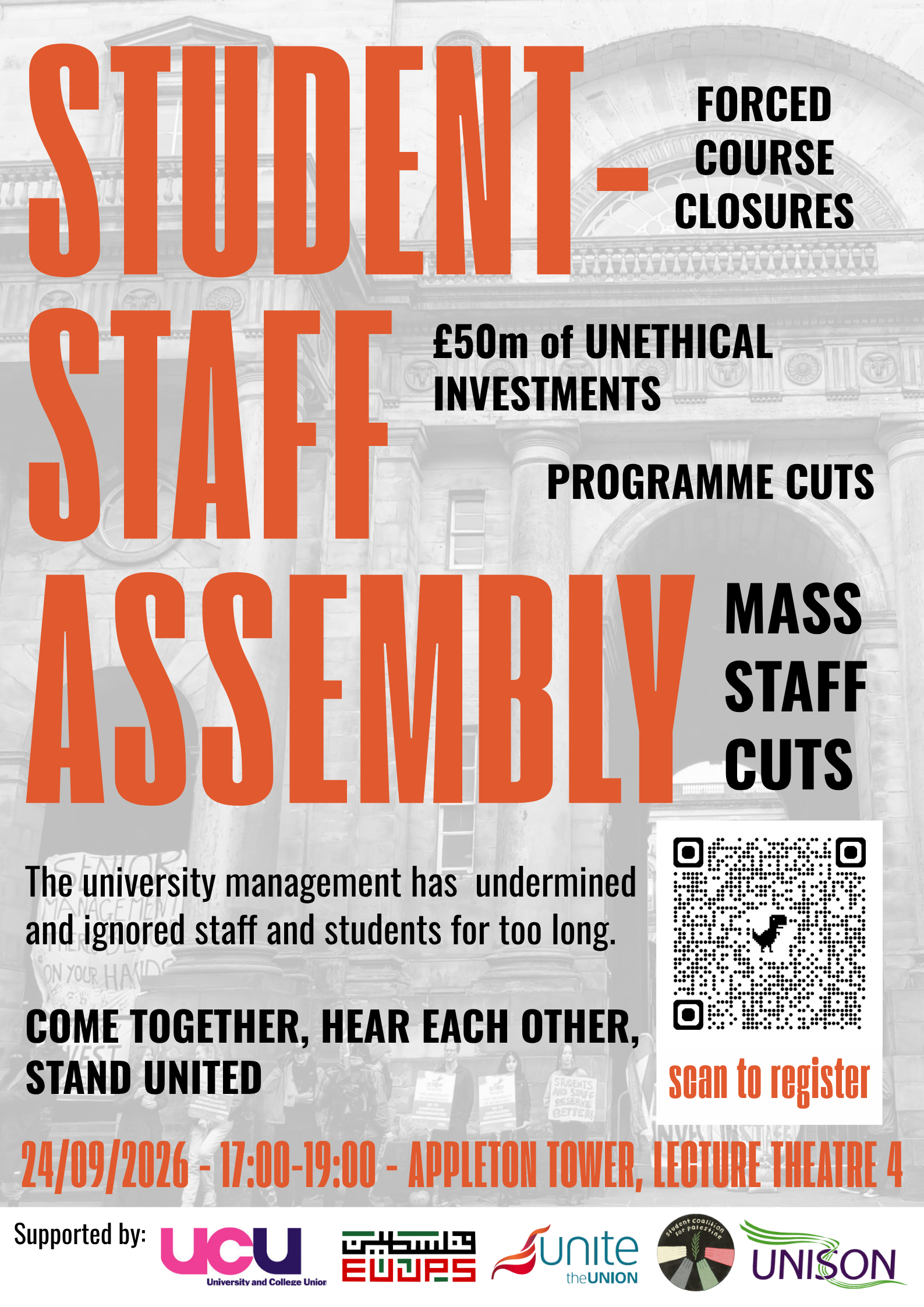
A poster advertising the Staff-Student Assembly, September 24 2026, Appleton Tower Lecture Theatre 4 (5-7 pm)